 Housing Market and Leisure Sector continue to lead recovery ...
Nationwide House Prices House prices increased at a rate of almost 6% in October according to the Nationwide House Price Index. Access to finance, a result of FLS and H2B have improved the willingness of buyers to step into the market. The housing market is up, up and away as our October review of the UK Housing market confirms. Is there a boom in prospect? Robert Gardner, Nationwide's Chief Economist, points out that “while house price growth has picked up - prices remain 7% below their 2007 peak.” Houses are generally affordable - ‘typical mortgage servicing costs remain modest by historic standards thanks to the ultra-low level of interest rates. A typical mortgage payment for a first time buyer is currently equal to around 29% of take home pay, in line with the long term average.” Well it won’t take long for the price lag to be wiped out, even on the Nationwide index. The “real cost of borrowing” is negative - borrowing rates are lower than asset price rises. The essential conditions for market expansion. We expect transactions to increase above one million this year, still well below the peak of 2007. No boom in prospect but a healthy recovery is in train, the house market is up, up and away on a sustainable growth path. Service Sector Growth The service sector continues to provide the back bone of growth in the economy, with growth accelerating to over 2% for the year as a whole. The leisure sector is now the fastest growing sector of the UK economy. Distribution, hotels and leisure have expanded at a rate of 4% in the year. Check out our Service Sector Update for November. Six slides to explain just what is happening in the UK economy. Manufacturing Not the march of the makers, that’s for sure. The latest Markit/CIPS UK Manufacturing PMI® survey was released on Friday. The index slipped to 56.0 in October, down from a revised reading of 56.3 in September. “The UK manufacturing sector continued a strong third quarter performance into the final quarter of the year according to the summary”. Yet manufacturing growth in the third quarter was pretty flat. Nevertheless we still expect growth of over 2% in the final quarter of the year (in manufacturing). Last year was such a dismal quarter, even the stumbling marchers can make progress. So what does this all mean? The economy is recovering and growing at a much faster rate into the final quarter. We still think base rates are now more likely to rise by around 50 basis points in 2015 rather than 2016. We still say this, despite the decision by the Fed this week to hold rates and continue with QE. Growth in the US is weak, inflation is below target and the housing market is confusing analysts. We expect tapering will be back on the agenda in the New Year as we migrate to Planet Janet. What happened to sterling? It was all about the dollar this week. Sterling slipped against the dollar but moved up against the Euro. The pound closed at £1.5912 from £1.6166. Against the Euro, Sterling closed at €1.1814 from €1.1713. The dollar moved up against the yen closing at ¥98.7 from ¥97.4, closing at 1.3484 from 1.3803 against the Euro. Oil Price Brent Crude closed at $105.91 from $106.93. The average price in November last year was almost $110. We expect Brent Crude to average $110 - $115 in the month, with no material inflationary impact. Markets, pushed higher - The Dow closed at 15,616 up from 15,570. The FTSE closed at 6,7351 from 6,721. The rally continues. UK Ten year gilt yields closed at 2.66 from 2.63 US Treasury yields closed at 2.62 from 2.51. Gold closed at $1,312 from $1,352. The bulls may have it but are pegged and penned for the moment. That’s all for this week, don’t miss The Sunday Times and Croissants out tomorrow and watch out for news of our Friday Financials Feature with Monthly Markets updates coming soon. Join the mailing list for The Saturday Economist or forward to a friend UK Economics news and analysis : no politics, no dogma, no polemics, just facts. John © 2013 The Saturday Economist, #TheSaturdayEconomist, by John Ashcroft and Company, Dimensions of Strategy and The Apple Case Study. The material is based upon information which we consider to be reliable but we do not represent that it is accurate or complete and it should not be relied upon as such. We accept no liability for errors, or omissions of opinion or fact. In particular, no reliance should be placed on the comments on trends in financial markets. The receipt of this email should not be construed as the giving of investment advice.
0 Comments
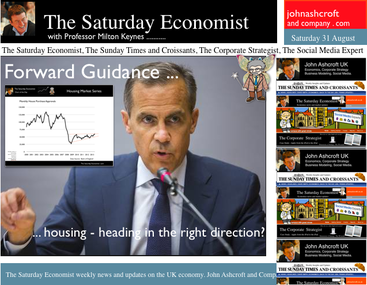 Economics news – the Governor speaks on forward guidance ...
A relatively quiet week for UK economics news. Nationwide announced house prices increased by 3.5% over the past twelve months and the Bank of England reported the number of mortgage approvals for house purchases had increased to 60,624 compared to around 48,000 in July last year. That’s a 30% increase in activity over the year. Housing Boom? The Funding for Lending Scheme and the Help to Buy scheme are stimulating a recovery, already manifest over the last three years. Are we about to experience a housing boom? Well not just yet. Activity is still a long way off the top, half the level of January 2007 and still way down from the average 100,000 level experienced from 2000 to 2007. Even so, Treasury would be wise to re-examine the plans for Help to Buy phase 2. This the plan to support LTV ratios for all house purchase transactions (under £600,000). An election winner perhaps, but Chancellor Osborne should heed the words of Jack Kennedy senior. “Dear Jack, Don't buy a single vote more than is necessary. I'll be damned if I'm going to pay for a landslide.” Yes, the house market is on the move, no need to rock the foundations in the process. In Nottingham, Mark Carney made a key speech to business leaders reaffirming the foundations of forward guidance. The governor offered further reassurance base rates would be kept on hold until unemployment falls below 7%, probably 2016 at the earliest. An opportunity for businesses to invest and households to spend wisely in the interim. The Governor stressed the 2% CPI inflation target is still paramount beyond the medium term. At present, 2.4% CPI is a more realistic inflation target for the foreseeable future and probably the Governor’s tenure in office for that matter. Markets believe 2015 may see the first rise in base rates, the governor suggests, it’s a three year wait. We suspect more QE is off the agenda, now the old regime has moved aside. Interesting the Governor is decoupling base rates from long term gilt rates. The Governor keen to stress the MPC controls the short rate no matter what markets may think or do. Just as well, markets will push the gilt curve back into shape, offering a real yield over the ten year horizon and about time to. Good news for the banks and lending, the governor announced an easing of liquidity requirements once the 7% capital ratios have been achieved. Here is a central banker who talks to the banks. Moral dilemma confined to the tutorial room. A pragmatist not limited by theory and dogma. A man with whom we can all do business. The Governor skillfully avoided any comment on exchange rates “some will go up and some will go down” the actual remark. Those who thought the new regime would seek further currency weakness will be disappointed. What’s wrong with forward guidance. Not much. FG offers a commitment to securing growth at the expense of an inflation trade, off in the recovery phase. Policy makers are concerned about making a move (on rates) too soon in the cycle. Japan revisited and a lost decade in prospect, if monetary policy is tightened too quickly and escape velocity is not secured. The risk at the moment, still slightly to the downside, as world trade slows, despite the evidence of UK recovery. Is there a risk of runaway inflation? Not really. Despite domestic and international price pressures, the substantial output gap, relative to trend rate of growth, will ensure there will be no runaway inflation. Real wages will improve over the next few years but substantial escalation will be avoided. In any case, FG offers guidance with lots of small print. Rates may rise at any time within the guidelines. Borrowers beware. During the past week, the downward pressure on the BISTO kids continued with the currencies of Brazil, India, Indonesia, South Africa and Turkey coming under further strain. Brazil has won the plaudits for swift action which included a substantial $60 billion foreign currency intervention plus base rate increases of 200 basis points, to a current level of 9%. Growth may be the victim as down grades follow, lower inflation currently at 6% the prize, plus, some element of stability in the exchange rate, the bonus. In India, growth forecasts have been cut to 4.5%. Inflation at 10%, a large government deficit and a $250 billion external funding requirement do not augur well for the rupee as the world faces a run to the Dollar. International hot money flows estimated at 15% of global GDP are on the move, as the prospect of the “start of the beginning of tapering” in the USA pushes up yields on Treasuries and funds are repatriated towards the homeland. The depth of foreign currency reserves and the limits to foreign debt, the real key to weathering the storm. Brazil better placed than India to withstand the cyclical pressure, which inevitably leads to capital flight at the expense of domestic asset prices, bonds, equities and real estate. Capital controls, fixed exchange rates and interest rate policies, the “trilemma” for policy makers. Hot money, leverage and asset price hikes the price of international liquidity. Yes, long term rates are on the move as bond prices come under pressure. Pack the bags and forward the luggage, we are leaving Planet ZIRP. Gold bulls have marked the next direction for the old relic. Black gold, is also on the move. Oil prices came under pressure as the prospect of an escalation of the Syrian crisis pushed prices to $114 dollars per barrel. What happened to sterling? Sterling responded to the economics news, moving lower the dollar but up against the Euro. The pound closed at $1.5494 from $1.5569 and at €1.1719 from €1.1629 against the euro. The dollar moved up against the yen closing at ¥98.1 from ¥98.6 Oil Price Brent Crude closed up at $114 from $111. The average price in August last year was almost $115. We expect oil to average $112 in the current quarter. Markets, slipped - The Dow closed down at 14,810 from 15,010. The FTSE closed down at 6,413 from 6,492. A further chance for market makers to clean out the bear pit as Syrian uncertainty adds to the shift. A good time to average in? We still think the FTSE will clear 7000 within ten weeks. UK Ten year gilt yields closed up at 2.79 from 2.72, US Treasury yields closed at 2.79 from 2.82. Gold closed up at $1,394 from $1,397. The bulls have it or do they? That’s all for this week, If you enjoy the Saturday Economist, why not forward to a colleague of friend. Here's is the link to join the Mailing list for The Saturday Economist. John 10,000 now receive the Saturday Economist each week. UK Economics news and analysis : no politics, no dogma, no polemics, just facts. John Ashcroft - the Saturday Economist, Chief Economist at the Greater Manchester Chamber of Commerce, Economics Adviser to Duff & Phelps and Chief Executive of pro.manchester. The views expressed are personal and in no way reflect the policy statements of organisations with which we work. The material is based upon information which we consider to be reliable but we do not represent that it is accurate or complete and it should not be relied upon as such. We accept no liability for errors, or omissions of opinion or fact. In particular, no reliance should be placed on the comments on trends in financial markets. The receipt of this email should not be construed as the giving of investment advice. It's just for fun, what's not to like! Dr John Ashcroft is The Saturday Economist. |
The Saturday EconomistAuthorJohn Ashcroft publishes the Saturday Economist. Join the mailing list for updates on the UK and World Economy. Archives
November 2026
Categories
All
|
| The Saturday Economist |
 RSS Feed
