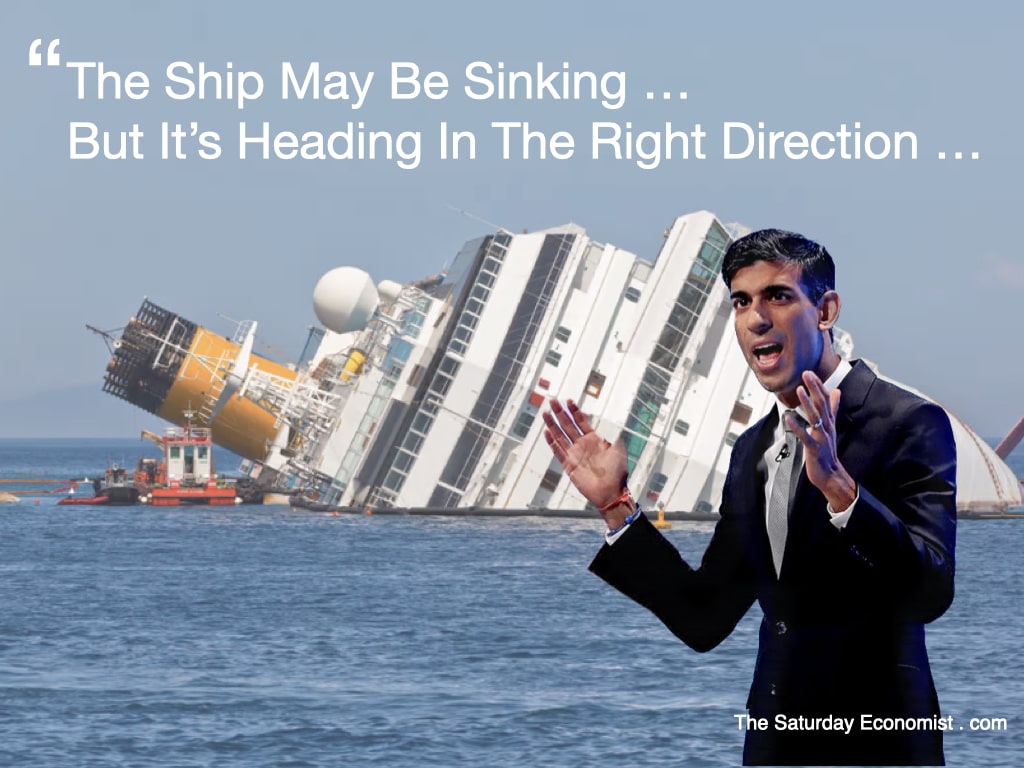
 This is it. This is the election year. The date of the budget (March 6th) opens up the prospect of a May election. We would model and assume a May election but ...
The latest poll data released this morning suggest the Conservatives are on course for a 1997-style electoral wipe out. A major new YouGov survey commissioned by Tory critics of Rishi Sunak, suggests Labour would win a 120-seat majority, if an election were held today. The Prime Minister has signaled that Britain's general election will take place in the autumn. His "working assumption" is the UK would go to the polls in the second half of this year. November 14th has emerged as the favorite date. In a recent interview with Laura Kuenssberg, Sunak pleaded for more time to finish the job. "The economy has turned the corner, we are pointing in the right direction. Give me a chance to finish the job. Stick with our plan. A plan that is working." Rishi Sunak kicked off the election year trying to sell to voters that his five pledges were on track. They should vote for him to finish the job rather than "going back to square one". OK, inflation has halved but waiting lists are higher. The boats are still coming. Immigration levels has soared. National debt has risen to 88.3% of GDP. The economy is flat lining. When he made those pledges, Mr Sunak told his audience "people don't want politicians who promise the Earth and fail to deliver". Yet even his own back benchers are having their doubts. Former energy minister Chris Skidmore has said he will resign when parliament returns next week over new legislation "that promotes the production of new oil and gas". Deputy Conservative Party chairman Lee Anderson and other senior Tory figures are voting against the government in favor of amendments to the Rwanda Bill. Kuenssberg has said that 53 Tory MPs have already said they're going to stand down before the next election. Lord Frost, the former Brexit minister, wrote in a piece for The Telegraph that if the Tories do not change course now "there will soon only be smoking rubble left." Grant Shapps, the Defence Secretary, has insisted that the Conservatives can "absolutely" turn around dire polling as the economy improves. Shapps pointed to tax cuts and falling inflation, suggesting that Sunak's government was pinning its hopes on people feeling better off later this year. "The reason I think we can turn it around is because at least people know we've got a plan and we're working to it", he told Times Radio this morning. It is possible a reduction in income tax and inheritance tax rates could feature in the budget but will it be enough to turn the fortunes of the Tory Party around? In the latest update we outline our forecasts for 2024. The economy may be flat lining but modest growth is in prospect never the less ...
0 Comments
 We track ten markets in our global equities model. The Dow, S&P and NASDAQ in the U.S.A, the FTSE, CAC and Dax in Europe. In Asia, Nikkei, Hang Seng, Shanghai and BSE feature. This is our review of 2023.
Global equity markets experienced their strongest year since 2019, with the MSCI World index, a broad gauge of global developed market equities, surging by 22%. This performance was driven by a strong rally towards the end of the year, as investors anticipated that major central banks had finished raising interest rates and would implement significant rate cuts in 2024. In the United States, the NASDAQ led the way with a 43% increase, followed by the S&P 500 index with a 24% rise, and the Dow Jones Industrial Average with a 14% gain. This growth was largely driven by a shift in interest rate expectations, as recent data showed inflation falling faster than expected in western economies. The Federal Reserve signaled the possibility of substantial rate cuts in 2024, which further fueled this optimism. European stocks also performed well in 2023, with the German DAX and French CAC indices rising by 20% and 16.5% respectively. However, the FTSE lagged behind, closing just above the 7700 level, for a 4% gain in the year. Asian markets had a mixed performance. The Nikkei index in Japan surged by 28%, and the BSE index in India was up by 19%. However, concerns about the investment outlook in China led to a 4% fall in the Shanghai index and a 14% drop in the Hong Kong Hang Seng. A handful of big technology stocks, known as the "Magnificent Seven" (Apple, Microsoft, Alphabet, Amazon, Tesla, Meta, and Nvidia), drove a large part of the gains on Wall Street in the year. Looking ahead to 2024, some investors believe that markets may be pricing in too much optimism that inflation will continue to trend lower without the US economy slipping into recession. Expectations of significant rate cuts in the USA and UK could be overblown, and the 40% gain in NASDAQ stocks may need a period of repricing before further gains are possible. Our premium to value is 5%, with significant stress still evident in Hang Seng and Shanghai. The contrarians would appear to benefit from a move into Hang Seng and Shanghai as Europe and U.S. appear over priced. Nikkei continues to look over played. We would look for a 10% correction in the US and a 5% adjustment in Europe.  At loose in the Conservative Party at the moment appear to be 'Five Families" a reference to the Five Mafia Families of New York each with its own unique agenda and objectives. In this article, we will explore the five prominent families within the Conservative Party: the European Research Group (ERG), the New Conservatives, the Northern Research Group (NRG), the Common Sense Group, and the Conservative Growth Group. We'll delve into their origins, key figures, and their impact on the political landscape.
The European Research Group (ERG)) Once a dominant force, the ERG played a pivotal role in shaping Brexit policy and ousting Theresa May. However, its influence waned after Brexit. The group recently resurfaced, aiming to scrutinize government legislation, particularly the Rwanda policy. Led by Sir Bill Cash and Mark Francois, the ERG remains a voice on the right of the party, cooperating with other backbench groups to maintain relevance. The New Conservatives The New Conservatives, a right-wing group primarily composed of "red wall" MPs, poses a significant challenge to the government, particularly Chancellor Rishi Sunak. Led by Danny Kruger and Miriam Cates, they advocate for policies such as migration curbs and oppose "gender ideology" in schools. Their hardline stance on various issues puts pressure on the party leadership, albeit they are a relatively new caucus. The Northern Research Group (NRG) formed by northern Conservative MPs after the 2019 election, champions increased investment in the north and seeks to amplify the voices of these regions. Led by Jake Berry and Esther McVey, they demand a Cabinet minister for the North and the construction of 500,000 new homes, positioning themselves as potential "kingmakers" in future elections. Conservative Growth Group Emerging after Liz Truss's brief tenure as Prime Minister, the Conservative Growth Group advocates libertarian-style economic policies. Led by figures like Sir Simon Clarke and Dame Priti Patel, they call for cuts in corporation tax and stamp duty, easing planning regulations, and resuming fracking. While not widely publicized, their influence shouldn't be underestimated. The Common Sense Group Founded in 2020, the Common Sense Group aims to combat "woke" culture. Comprising MPs who advocate a broad range of ideals, they've been critical of organizations like the National Trust. This group, inspired by the European Research Group, has around 59 MPs and 7 members of the House of Lords in its ranks. One Nation Tories The One Nation Conservatives promote compassionate and realistic policies. Led by Damian Green, they represent centrist Tories and aim to govern within the One Nation tradition. While historically less influential, they have recently gained ground, particularly on the issue of migration. Some of their members hold positions within the government. They are excluded from the "Family Photo'.. Conclusion These five families within the Conservative Party in the UK illustrate the diversity of thought and priorities within the party. As they continue to shape policy and influence the political landscape, understanding their origins and key figures is crucial in assessing the future direction of the Conservative Party. Good Luck with that!  Introduction
In a surprising turn of events, former Prime Minister David Cameron made a remarkable return to British politics, taking up the role of Foreign Secretary in Prime Minister Rishi Sunak's cabinet. Cameron has been elevated to the House of Lords as Baron Cameron of Chipping Norton. This unexpected development has generated significant interest and speculation, as Cameron sets out to tackle pressing issues both on the domestic and international fronts. Brexit and Support for Leaving the EU One of the most remarkable aspects of Cameron's return to government is his stance on Brexit. Despite leading the "Remain" campaign during the 2016 EU referendum, he has now voiced strong support for the decision to leave the European Union. In his own words, "I fully respect the will of the British people”. My objective is to make Britain "secure and prosperous in a difficult and dangerous world.” Critics within the party will still consider him to be a closet remainer. Foreign Aid Policy Another critical area of focus for Cameron is foreign aid. He has been an advocate for maintaining the UK's commitment to spending 0.7% of GDP on foreign aid, emphasising the importance of international development and humanitarian efforts in a global context. HS2 Project Cameron's return has also raised questions about his stance on domestic infrastructure projects, particularly HS2. While in office, he championed the high-speed rail project, and it remains to be seen how supportive he can be on the government stance on infrastructure investment now. . China Relations With China's rising influence on the global stage, Cameron's role as Foreign Secretary places him in a position to shape the UK's relations with the global superpower. His approach to balancing economic interests with human rights concerns will be closely watched. Cameron is considered to be a Sinophile, drinking Beer in the Pub with President Xi Jinping on his visit to the UK in 2015. During his visit, he and then-Prime Minister David Cameron visited The Plough at Cadsden, a pub in Buckinghamshire. The visit to the pub was an informal and friendly gesture to showcase British hospitality and strengthen diplomatic ties. The European Court of Human Rights Cameron's tenure as Foreign Secretary also presents an opportunity to address the UK's relationship with international bodies such as the European Court of Human Rights. His perspective on the court's jurisdiction and its impact on British law will be pivotal. Cameron is considered to be a supporter of the The European Court of Human Rights and the UN commission on Human rights, Confronting UKIP's Legacy David Cameron famously described UKIP members as "closet racists and fruitcakes" during his time as Prime Minister. His return may provide an opportunity to address the legacy of UKIP and its impact on contemporary British politics. Conclusion David Cameron's return to government as Foreign Secretary marks a significant moment in UK politics. His evolving positions on Brexit, foreign aid, HS2, China, and international institutions will shape the nation's foreign policy landscape. With a clear objective of securing Britain's prosperity in a complex world, Cameron's role will undoubtedly be a subject of intense scrutiny and debate in the coming months and hopefully years. " Great Britain: Secure and prosperous in a difficult and dangerous world." 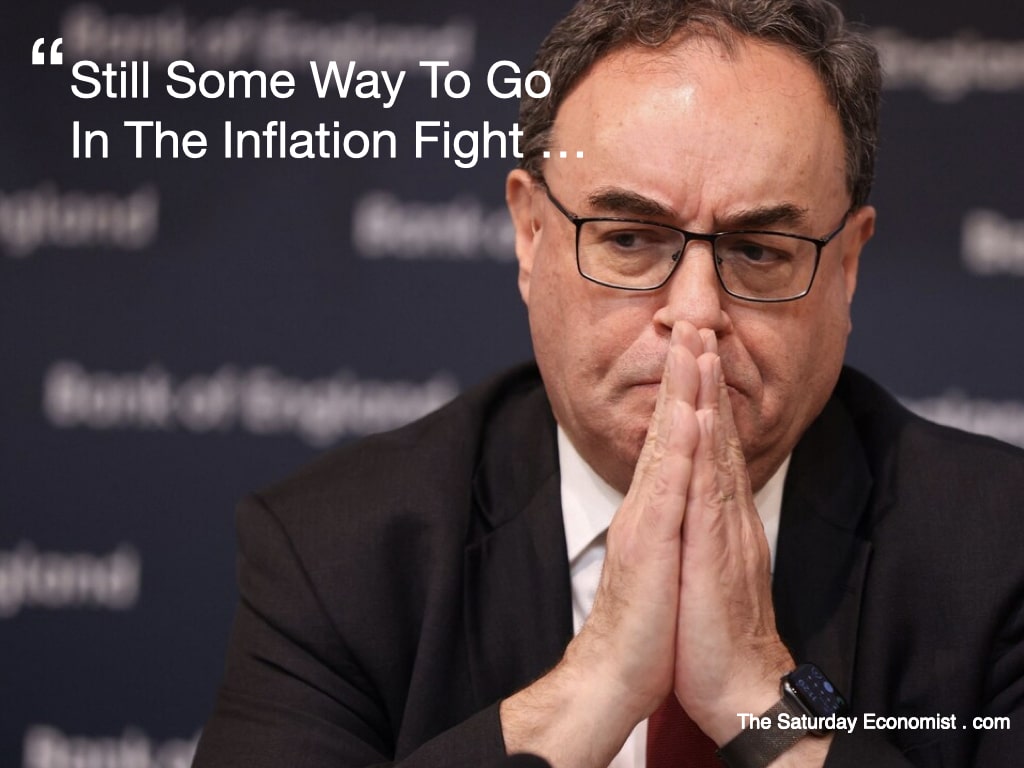 On Wednesday the U.S. Federal Reserve held interest rates unchanged. The target range for the Fed Funds Rate was maintained at 5.25% and 5.5%. The formal statement issued by the FOMC was cautious and guarded.
"The Committee would be prepared to adjust the stance of monetary policy as appropriate if risks emerge that could impede the attainment of the Committee's goals." Risk sentiment in markets was boosted as the central bank revealed policymakers were penciling in at least three rate cuts next year according to the latest Blue Dot Plot. The average rate projection was 4.5% by the end of the year compared to 5.0% in September. On Thursday, both the Bank of England and the European Central Bank also kept interest rates unchanged. Governor Andrew Bailey pushed back against market expectations of early rate cuts next year. Retaining the hawkish guidance that monetary policy is "likely to need to be restrictive for an extended period of time." Christine Lagarde also waved off hopes of early rate cuts from the ECB. Headline inflation may have fallen and the growth outlook may have weakened but domestic inflation remained high. Wage growth levels (a major drive of domestic inflation) were incompatible with the inflation target of 2%, she said. Fed Offers Sobering Message ... In the news conference on Wednesday, and in written statements following, the Fed did what it could to restrain the Wall Street bulls. "It's far too early to declare victory and there are certainly risks still facing the economy", Jerome H. Powell, the Fed chair, said. The Fed indicated that it was too early to count on a "soft landing" for the economy. A reduction in inflation without a recession is increasingly the Wall Street consensus. Inflation, the glaring economic problem at the start of the year, has dropped sharply thanks, in part, to steep interest rate increases and a drop in energy prices. The Consumer Price Index rose 3.1 percent in the year through November. That was still substantially above the Fed target of 2 percent, but way below the inflation peak of 9.1 percent in June 2022. Producer prices were up just 0.2% in November. An early decline in the federal funds rate, the benchmark short-term rate that the Fed controls directly, isn't a sure thing but stocks shot higher anyway, with the S&P 500 on the verge of a record. Christine Lagarde Struck A Hawkish Tone ... The European Central Bank left interest rates unchanged at a record high of 4 per cent this week. Christine Lagarde, president of the ECB, struck a hawkish tone after Thursday's decision, saying "Should we lower our guard? We asked ourselves that question. No we should absolutely not lower our guard. We did not discuss rate cuts at all. No discussion, no debate." While acknowledging that underlying price pressures were easing, Lagarde said domestic inflation, largely driven by wage costs across the twenty countries that use the euro, was "not budging". Future inflation risks ranged from geopolitical tensions that could push energy prices higher in 2024 through to more extreme weather that could damage next year's harvests, she added. Governing Council member Francois Villeroy said "In mountains there are peaks and descents and there are plateaus. Today we are on a plateau and we need to give ourselves time to enjoy the view, to appreciate the effects of monetary policy." "Barring shocks or surprises, rate hikes are over but that doesn't mean a quick rate cut is coming", Villeroy said Friday. Bailey warns rates may need to rise again ... Governor Andrew Bailey says he can't say definitively "that interest rates have peaked". The Bank of England has signaled it may not be finished raising interest rates as Bailey warned there was "still some way to go" in Britain's inflation fight. The Bank said price rises were proving more stubborn in Britain than in other developed economies. CPI inflation had fallen back as expected to 4.6% in October. Service sector inflation remained high at 6.6%. Latest earnings data suggested wages were rising at the rate of 7%. A rate incompatible with the 2% CPI target. Mr Bailey said it was "too early to start speculating about cutting interest rates" as the MPC warned that "further tightening" would be necessary if price pressures persist. Hawks continue to baulk about an easing of monetary policy At the meeting, the Monetary Policy Committee (MPC) voted 6-3 to keep borrowing costs on hold at 5.25pc. Three members (Megan Greene, Jonathan Haskel and Catherine Mann) voted against the proposition, preferring to increase bank rate by a further 0.25% to 5.5%. The hawkish stance on monetary policy is at odds with the Governor's gloomy outlook on the economy. The latest ONS data suggests economic expansion was confined to just 0.2% in October. The MPC missed the opportunity to hike rates at the November meeting. The MPC is now encamped on the plateau enjoying the view. Table Mountain versus the Matterhorn policy perhaps. The hawkish stance is also incompatible with a government up for re-election next year. Calls for the Bank to ease off on interest rates are likely to grow in the months ahead. The Tories are already over twenty points behind in the polls. The Bank may just be able to offer a rate cut in the Spring. But unlike the election, it will be close run thing. Want to know more? Check out our Friday Forward Guidance updated every week. https://www.thesaturdayeconomist.com/friday-forward-guidance.html 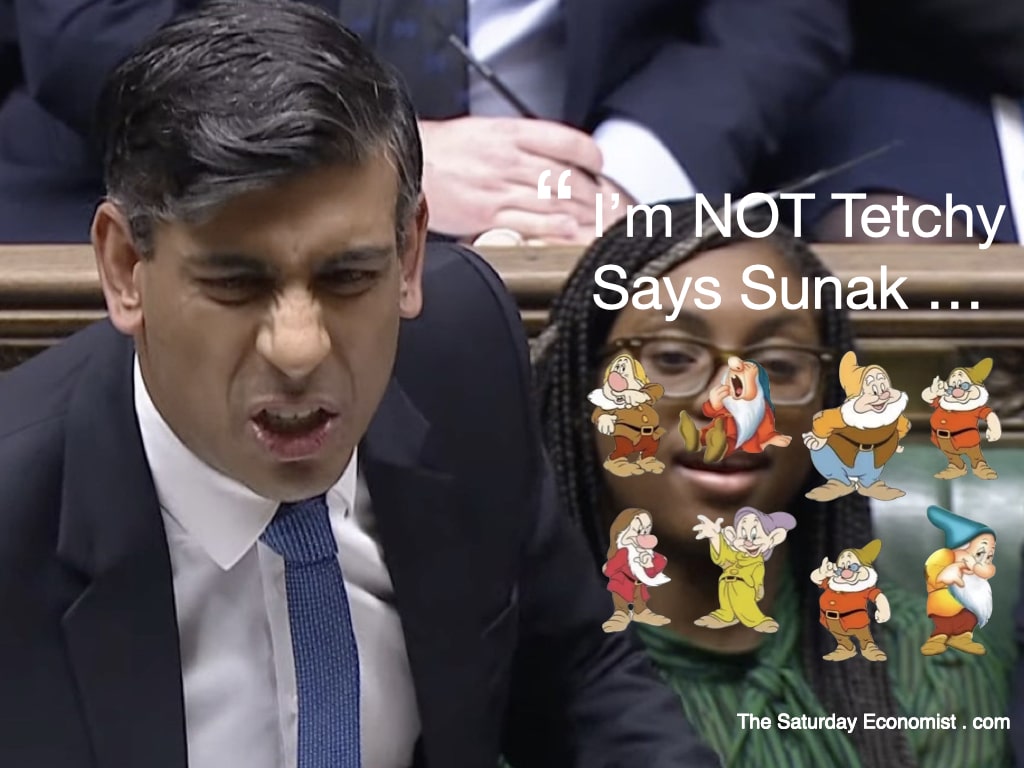 "I'm not tetchy" barked the Prime Minister. The British PM has been accused by both critics and allies of being bad-tempered in recent weeks. Rishi Sunak has denied being “tetchy”, insisting he just gets “frustrated” when things don’t work out as hoped.
“I don’t understand that term … there’s nothing tetchy, (about me), the prime minister told the Spectator magazine. It was as if Sunak had added a new character to the fairy tale of Snow White and the Seven Dwarfs, not Happy, Grumpy, Sleepy, Dopey, Bashful or Sneezy and certainly not Tetchy. Tracking the number of dwarfs in the original Brothers Grimm fairy tale is easy. Historical reference for the latter (with names) is provided by Walt Disney in the 1937 animation "Snow White and the Seven Dwarfs". Tracking the number of families in the Conservative party is becoming more difficult. There would appear to be five families in the camp. A reference to the five families controlling the mafia in New York in the 1930s, including the Colombo, Gambino, Genovese, and Lucchese families. The mafia families were involved in criminal activities, including racketeering, extortion, drug trafficking and prostitution. They had a long history of organized crime in New York City, Long Island, New Jersey and Florida. The families were organised under the leadership of a "Capo dei Capi" but a series of assassinations, led to the abandonment of the role (it was too high risk) and a more democratic structure was put in place under a mafia "commission". So what of the Tories? The five families of the Conservative party include the European Research Group (ERG), the New Conservatives, the Northern Research Group (NRG), the Common Sense Group and the Conservative Growth Group. On the sideline for the moment appear to be the "One Nation Tories", and the ABR "Anyone But Rishi" Group. Key questions remain. Under the five family structure, is Sunak the high risk capo di capi or is the Tory Back Bench 1922 committee the "Commission?" Some suggest “The ‘five families’ thing is complete bullshit. It is something that Mark Francois (leader of the ERG) and John Hayes, (leader of the Common Sense Group) like, because it makes them feel personally important." So what happened to the great Rwanda debate? According to Iain Martin in The Times, "After all the pompous huffing and puffing, all the ultimatums and dark threats, the Tory Right’s great Rwanda rebellion against Rishi Sunak that was meant to rock the government, or perhaps even bring it down, turned out to be a parliamentary peashooter." The bill was passed with a majority of 44. There appeared to be thirty or so abstentions from the Tory "Cosa Nostra". It was Shakespearean event more comedy than drama. "Much ado about nothing" just about sums it up. They're maybe a second act in the third reading of the bill to follow. By then the Tories will realize the threat of a stay on the Bibby Stockholm, is a greater deterrent than any flight to Rwanda. 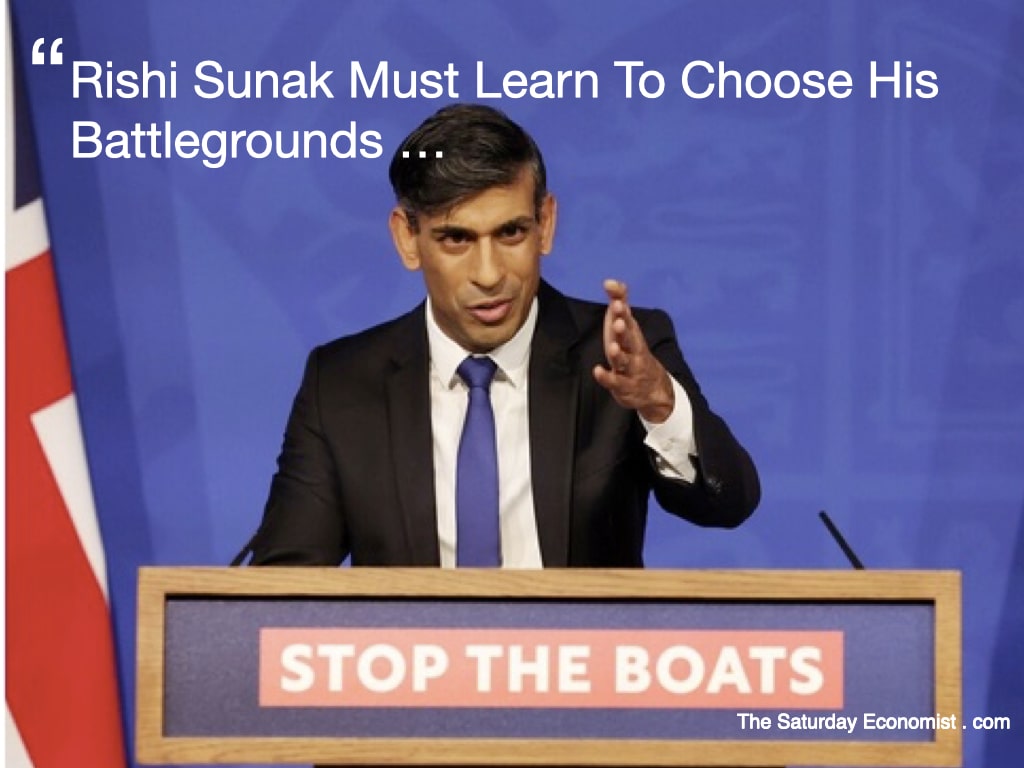 It was Priti Patel who opted for the Rwanda solution apparently. It was a choice between the Falkland Islands and Stockton on Tees. In the end the African nation become the deportation option of choice. There were fewer Tory voters in residence. OK there were some drawbacks to the Rwandan option. Human rights abuses and political repression featured. Some might feel, a country with a history including the 1994 genocide wasn't exactly a safe option. Issues of "Refoulement" held sway. Refoulement refers to the act of forcing a refugee or asylum seeker to return to a country where they are likely to face persecution or danger. It is a fundamental principle of international law forbidding a country receiving asylum seekers from returning them to a country where they would be at risk. Rwanda has a history of refoulement. The UK Supreme Court ruled that it would be unlawful to remove refugees to Rwanda due to the risk of refoulement, concluding Rwanda is not a "safe" option. Rishi Sunak, was never a great fan ... At origin, Rishi Sunak, as Chancellor of the Exchequer was never a great fan. According to Matt Chorley in the Times, "Sunak hated the daft idea". Sunak and his Treasury team didn't think much of the policy, privately raising concerns with Downing Street and Cabinet colleagues about whether it would work and if it provided value for money. Several people involved in the discussions said Sunak also had objections on ethical grounds. James Cleverly, Home Secretary, has been accused of calling the government's Rwanda policy "batshit". [He has repeatedly refused to confirm or deny using that term.] As indeed, he has never made derogatory remarks about Stockton on Tees, just their local MP. The plan has been widely condemned as inhumane, illegal, unworkable, and prohibitively expensive. Critics have included Tory MPs and Peers, the UN's refugee agency (UNHCR), the Archbishop of Canterbury and Gary Lineker. Sunak had the option to drop the plan but decided to "plough on" regardless. He was prepared to sack HS2 but stuck with Rwanda in his commitment to "Stop the Boats". If only had promised to halve the boats and stop inflation he might have had a get out. The option appears to be to carry on regardless in a back me or sack, unite or die message, to the Tory rank and file. The government has now paid almost £300 million to the Rwandan government to prepare for the reception of the boat people. Hotel Rwanda has been readied along with the series of luxury apartments. Patel was so impressed she almost placed a deposit herself on a room with a view of the "land of a thousand hills". Shocked by the Supreme Court Ruling ... Shocked by the Supreme Court Ruling, the prime minister is pursuing a two-pronged strategy to overcome legal obstacles thrown up the the Court Challenge. First, the government has agreed to a new treaty that guarantees migrants relocated from Britain to Rwanda will not be sent back to their home country. Promise. Second Rwanda is a safe country. The UK government will declare in law that, thanks to safeguards enshrined in the treaty, Rwanda is a "safe country". It will instruct "every decision-maker", whether a Home Office official or a court or tribunal to "conclusively treat Rwanda as a safe country" when deciding whether to remove an individual to that country. [As an addendum to the bill, the government will write into law that Kensington, is a safe place to wear an Audemars Piaget watch, with a short sleeved shirt, driving a Porsche or Ferrari in the sunny season.] The European Court of Human Rights (ECHR) has also been involved in the UK's policy regarding the removal of asylum-seekers to Rwanda. The ECHR has already intervened, granting an urgent interim measure to prevent the removal of an individual to Rwanda. Judgments are binding on the 46 Council of Europe member states that have ratified the convention. If you want to start a fight in the Tory Party shout Europe ... The hard line European Research Group were outraged. To think that a European institution should menace the sovereignty of the land of pomp and glory. Suella Braverman set out to become the champion of the hard right. "We will fight them on the beaches and on the court benches" the call to action. We will opt out of ECHR (or anything with Europe in the title) the mantra. Just as well NATO doesn't become NEATO or we would have to quit that too. The Tory"Star Chamber" the ERG's lawyers has warned the legislation is not watertight enough to prevent legal challenges and is not fit for purpose. Robert Jenrick, the immigration minister, quit in the belief that the plans were too weak. In a pointed rebuttal to the Prime Minister, he said it was "very clear" to those who understood the issues, "the Bill will not work". Speaking on BBC's Sunday Show with Laura Kuennsberg, Jenrick said a political choice had been made to "bring forward a bill that doesn't do the job". He warned section four of the Bill allowing migrants to appeal their deportation on an individual basis would lead to a range of legal claims, which will "bog down the scheme and will not create the deterrent the Prime Minister and I set out to achieve." It really is time to axe the option ... According to the latest data, around 46,000 people were detected crossing the channel in 2022. This year the number is expected to fall below 30,000. Agreements with France and Albania have assisted the drop in numbers. Stuck on a barge with legionnaires disease doesn't appeal. Sunak has halved inflation and almost halved the number of boats crossing the channel. Meanwhile, the number of immigrants entering the country legally has hit 1.3 million over the last two years. Hard to see why the obsession with sending boat people to Rwanda is so intense. Sunak's policies are set to halve inflation, halve the number of boats and halve the number of Tory MPs if continued. The Prime Minister must learn to choose his battlegrounds ... Rwanda is not the one to fight them on the back benches .... 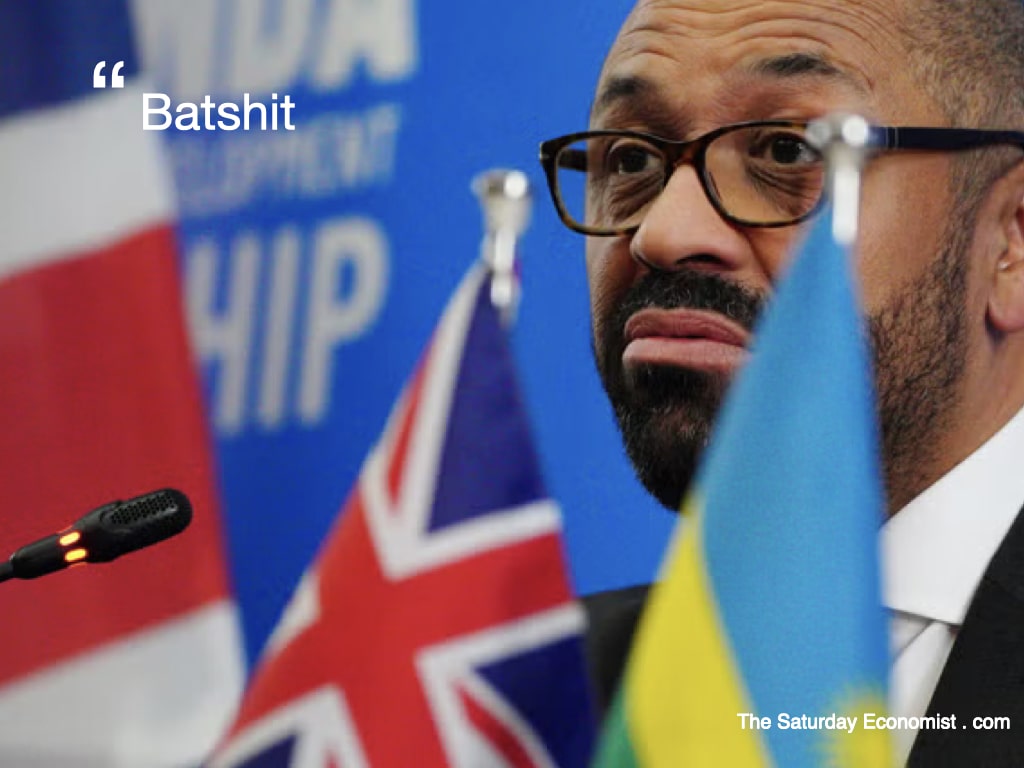 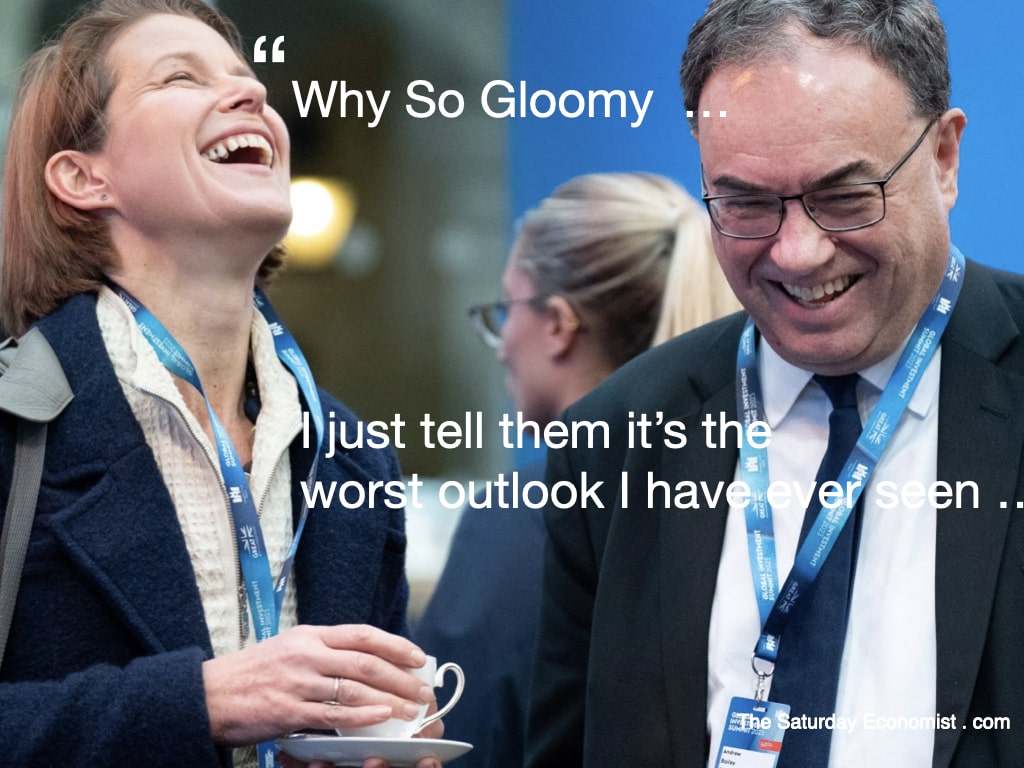 Andrew Bailey, the governor of the Bank of England, has hit back at critics who have claimed he has taken an "ultra pessimistic" view of the UK economy.
This week, Bailey painted an extremely dim picture of the UK economy, claiming that its present potential growth trajectory is the "worst" he has ever seen in his career. "I have been written up this week as being an ultra-pessimist, but I don't see it that way. I see it as a realist view,' Bailey told Staffordshire's Daily Focus newspaper. The Bank's latest forecasts indicate the economy will barely grow at all next year, or in 2025. The Governor has said the outlook for the economy is the worst he has ever seen. Britain struggles to boost low levels of growth, as taxes and interest rates rise. The Bank of England Governor raised concerns over the UK's future prospects just days after the Office for Budget Responsibility (OBR) issued forecasts for the UK economy slightly more optimistic than the Bank of England. In an interview with The Chronicle in Newcastle, Mr Bailey said: "If you look at what I call the potential growth rates of the economy, there's no doubt it's lower than it has been in much of my working life. "It does concern me the supply side of the economy has slowed. It does concern me a lot." Is The Governor Genetically Pessimistic? When asked at the OBR press conference "Why Are Your Forecasts for GDP Growth So much Stronger Than The Bank of England's November Forecasts?" Professor David Miles said (with a smile) "Because we are genetically more optimistic than the Central Bank". It's a fair point.. He then went one to say "Actually, that's not really true. The variance is best explained by the differences over the underlying trend rate of growth and assessments of total factor productivity. Adding the possibility of a possible varying stance on the future path of interest rates may also come into play. But in general the Bank has a more cautious, more conservative, more pessimistic view." Predictions of weak supply growth are one reason Mr Bailey and his colleagues on the Monetary Policy Committee (MPC) are keeping interest rates high. The governor added to warnings from Huw Pill, the Bank's chief economist, the supply side of the economy, which includes the availability of labour, could keep inflation stubbornly high over the coming years as a result of the ensuing pressure on wages. So What About Rates? The Bank of England will not cut interest rates for the "foreseeable future", Andrew Bailey has said, warning it was "too soon" to discuss the prospect of large-scale monetary easing. He warned the next stage of cutting inflation would be "hard work". So far, inflation has fallen from a peak of 11.1pc in October 2022 to 4.6pc last month, when a drop in the energy price cap pulled the headline rate down from September's 6.7pc. The Governor said the job is not done yet, and warned families not to expect any steep falls in interest rates as the Bank battles to get prices back to its 2pc target. "By the end of the first quarter next year, when a lot of that unwind will have happened, we may be a bit under 4pc (CPI) but we'll still have 2pc to go, maybe. And the rest of it has to be done by policy and monetary policy. And policy is operating in what I call a restrictive way at the moment." He stressed that this requires rates to stay at their current level of 5.25pc for some time, despite the pain it inflicts on borrowers. He said: "I am very conscious of the position of the less well-off but we do have to get it down to 2pc and that's why I have pushed back of late against assumptions that we're talking about cutting interest rates or we will be cutting interest in anything like the foreseeable future because it's too soon to have that discussion." Financial markets are currently betting that the first rate cut, from 5.25pc to 5pc, will come in the summer of 2024. Bailey and other Bank rate-setters have recently pushed back against financial market speculation that indicates at least two rates cuts before November next year, taking the base rate to around 4.75 per cent. That ain't go to happen says the governor! Why So Gloomy? The "Sexy Turtle" will have his sway on rates ... but the OBR will have it's day on growth ... 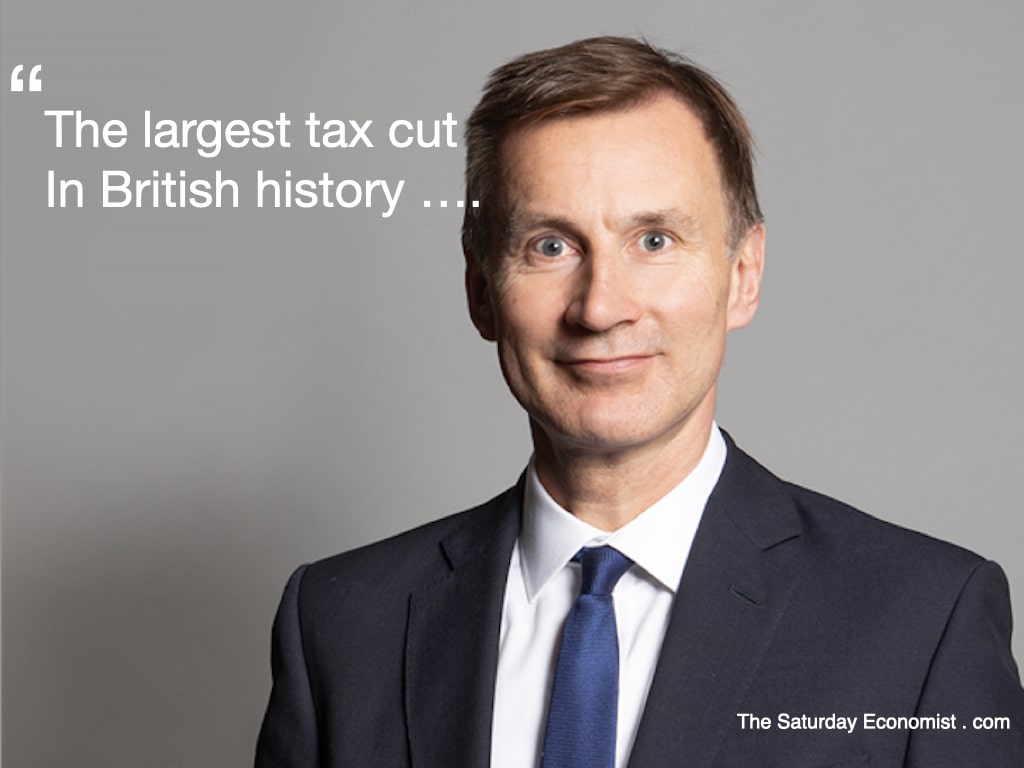 The Autumn statement was finally delivered on Wednesday. It was impeccable timing. Squeezed between the Supreme Court rejection of the Rwanda option and the release of the revised numbers for net migration. It was an "Autumn Statement for a country that has turned a corner", said the Chancellor. It was a statement for an economy that had "'hit a dead end" said the Shadow Chancellor Rachel Reeves.
The Autumn statement was a message of continuity. The next stage in the process. The process of thirteen years in government. A period which encompasses five prime ministers, seven chancellors, nine business secretaries and twelve growth strategies. The economy may have turned the corner but policy at times appears to be going round in circles. The Chancellor announced his economic advisory council, set up last Autumn, has, just one year later, been stood down. It was a statement with generous gives. Pensions uplifted by 8.5%. Welfare benefits uprated by 6.7%. A near 10% increase in the living wage and a 2% cut in the employee rate of National Insurance. Plus a permanent extension of "Full Expensing". The process in which capital expenditure on plant and machinery can be fully expensed against corporation tax in the accounting year. So where has the money come from? Just six weeks ago on the 4th October, The Chancellor warned there is no money, as the OBR advised of a £19 billion deficit. Now just 44 days later, there appeared to be a surplus of around £30 billion. A £50 billion swing in just six weeks. Increasing tax revenues from Corporation Tax and Incomes Taxes have been upgraded as tax hikes on CT and freezing of allowances on PAYE have boosted revenues. Higher inflation and higher incomes have generated "fiscal drag" forcing more into higher payments on higher rates. Nominal GDP has also been upgraded with a higher GDP deflator activated. Nominal GDP is forecast to increase by 6.7% in the current year. It could well be higher, rising by 8.5% despite the low rate of real growth in the year of just 0.6%. This is important in reducing debt and debt interest to GDP ratios even as debt continues to rise. Has the Chancellor been prudent? Not really. Hunt has taken a modest improvement in the public finance forecasts and spent most of it. The spending targets will be met by unspecified fiscal restraint (spending cuts) at some point in the future. The OBR have to accept the Treasury spending forecasts as given, despite any detail in year three onwards of the forecast period. Asterisk budgeting "cuts as yet to be identified" return. Health and Welfare are likely to be the beneficiaries. Local government, further education, justice, courts, prisons, HMRC the likely losers. On full expensing, On full expensing, Hunt said, "In the Spring, I introduced full expensing for three years. This means that for every million pounds a company invests, they get £250,000 off their tax bill in the very same year. 'The CBI, Make UK, Energy UK and 200 other business leaders have said making this measure permanent would the "single most transformational thing" I could do for business investment and growth. But because it costs £11 billion a year, I made clear that I would only do so when it was affordable." "Well, with inflation halved, borrowing down and debt falling, today I deliver on that promise. I will today make full expensing permanent. That is the largest business tax cut in modern British history." Will the impact be that great? The OBR say it will increase annual investment by around £3 billion a year and a total of £14 billion over the forecast period. Not much of a pay back on a tax cost of £11 billion a year. Fortunately, the OBR suggest the cost to the exchequer is a more modest £4.5 billion a year. [EFO Table 3.1]. The anticipated uplift to investment is also unrealised in the Economic Outlook. The UK capital stock is expected to increase by just 0.2% by the end of the forecast period. Investment reacts in a payback model, not so much to the cost of capital but the anticipated cash flows from higher rates of growth. The largest business tax cut in modern British history ? Hunt said it was "the largest business tax cut in modern British history". Paul Johnson, the Director of the IFS (Institute for Fiscal Studies director) suggested that was a "tiny bit cheeky"when contrasted with the much bigger hike in corporation tax, up from 19 per cent to 25 per cent. Corporation tax revenues will increase by 23% or £40 billion over the two year period this year and next as a result of higher CT rates. Income tax receipts will increase by £27 billion this year and over £20 billion next as a result of fiscal drag. A significant offset to the £10 billion National Insurance giveaway. Has the Chancellor has been prudent! The cuts had to be funded somehow. "I am going to increase duty on hand-rolling tobacco by an additional 10% above the tobacco duty escalator." He said. The IFS suggests there are adequate risks to the forecast outlook. There is no provision for the freeze on Fuel Duties to continue. (There has been no change since 2010, a cost of £6.2 billion). It assumes business Rate Relief £2.5 billion would stop in April and cuts in public service spending for unprotected departments could be worth £20.0 billion. So What Next? The OBR are forecasting growth of 0.6% this year, 0.7% next and 1.4% in 2023. Inflation is set to average 3.6% in 2024, falling to target in early 2025. Unemployment is set to peak at 1.6 million, a rate of 4.6%. Public sector net debt is expected to peak at 93% of GDP up from 89% this year. Borrowing is set to fall in each year of the forecast, even as interest payment rises to £120 billion. Markets reacted well to the Autumn statement. Sterling closed at $1.26 it was $1.21 at the end of October. Ten year gilt yields closed at 4.23%. The Tories jumped four points to close the gap on Labour, only to lose the gain as the immigration figures were released. Speculation already begins on the election date and content in the Spring budget. There could well be scope for a further income tax giveaway. Further NI or CT cuts would be unlikely. Inheritance Tax is hardly likely to shore up the Red Wall. On the whole it was a balanced Autumn statement, undermined by the inadequate provisions on spending, diminished by the Chancellor's claims of the "Largest Business Tax Cut in Modern British History" ... Cheeky or what!  Latest inflation figures were released on Wednesday. Inflation CPI basis eased to 4.6% in October from 6.7% prior month. The fall was marginally better than the expected 4.7%, boosted by the adjustment to energy prices and the Ofcom cap, as we explained last week.
The effect was a near 22% drop in energy prices year on year and a 1% plus drop in the headline inflation rate. Without this the government would be unable to claim credit for "halving the inflation rate". Unable to move on to the next objective, later this week, to stimulate "growth". What exactly Sunak and Hunt have done to achieve the halving objective is largely unclear. "VAT on children's clothing, I've scrapped that. VAT on food, I have scrapped that as well. VAT on protective boots for PMQs, I have scrapped that too. VAT on flights to Rwanda under review." Who could ask for more from Downing Street? Goods inflation eased to 2.9%. Service sector inflation, remained disturbingly high at 6.6%. Insurance costs continue to rise at over 20%. Food inflation was 10%. The underlying inflation rate was down to 5.7% from 6.1%. Producer price trends remain in negative territory. Output prices fell by -0.6%. Input prices were down by almost 4%. Oil prices sterling adjusted were down by almost 10% year on year. Latest earnings Data ... So good news on producer prices and goods inflation. Not quite so good on service sector inflation. The latest earnings data present additional cause for concern. The latest data for September suggest earnings growth was 7.9% year on year from from 8.2% prior month. (based on the 3 month average). Public sector earnings were 8.6%. Private sector earnings were 7.7%. Service sector pay growth was over 8%. The jobs market is tightening slowly. Vacancies have fallen from a peak of 1,300,000 in May last year to 957, 000 in the latest three month period to October. The unemployment rate is probably running at 4.5% into the fourth quarter, with an unemployment level of just over 1.5 million. According to experimental figures released by the Office for National Statistics Office last week, the unemployment rate was 4.2% in Q3 unchanged from the prior quarter. The jobs market is tightening, but average earnings at 8% is just not compatible with a 4% inflation target, let alone the 2% inflation mandate. The Bank of England will look for a slow down in earnings growth into the early part of next year if inflation targets are to be met. So What Happens next? Inflation is expected to average 4.5% in the final quarter of the year, then slowing to 3% by the end of 2024 according to the latest forecast from the Bank of England. This assumes a steady glide path through the year ahead. Let's hope so ... |
The Saturday EconomistAuthorJohn Ashcroft publishes the Saturday Economist. Join the mailing list for updates on the UK and World Economy. Archives
April 2024
Categories
All
|
| The Saturday Economist |
 RSS Feed
The material is based upon information which we consider to be reliable but we do not represent that it is accurate or complete and it should not be relied upon as such. We accept no liability for errors, or omissions of opinion or fact. In particular, no reliance should be placed on the comments on trends in financial markets. The presentation should not be construed as the giving of investment advice.
|
The Saturday Economist, weekly updates on the UK economy.
Sign Up Now! Stay Up To Date! | Privacy Policy | Terms and Conditions | |