 1 No charges for Biden in classified documents probe but ...
Joe Biden carelessly kept classified documents and notebooks at his home, according to a special counsel report released Thursday. The report said the evidence wasn't strong enough to charge the president with crimes. The report's description of Biden as "an elderly man with a poor memory" prompted a furious response from the president at a hastily called news conference hours later. The 345-page special counsel report portrayed Biden, 81, as someone who haphazardly kept notebooks and documents with classified information at his home, and struggled to recall key dates in his life. In concluding Biden should not be prosecuted, Special Counsel Robert Hur, a former Trump-appointed US Attorney in Maryland, offered a political indictment of the president's fitness. Hur described the leader of the free world as a "sympathetic, well-meaning, elderly man with a poor memory". This would make him impossible to prosecute (and difficult to elect). Republicans quickly seized on that stinging characterization to attack the Democratic incumbent as unfit for office, well no surprise in that! 2 Trump is on a glide path to the Republican nomination ... Trump is on a glide path to the Republican nomination, or should we say "coronation". Trump romped home in the Nevada and US Virgin Island caucuses Thursday night, continuing his unbeaten streak and making Nikki Haley's campaign appear futile. After wins Thursday in Nevada and the US Virgin Islands, Trump remains undefeated and in total command of the primary race. Trump's win in Nevada was never in doubt in a state where party leaders molded the delegate-awarding contest to benefit him. Trump's chief rival, Haley, was not even an option for caucus goers Thursday. Haley, the former South Carolina governor chose instead to take part in the state-run primary conducted earlier this week, where Trump was not on the ballot. Haley finished second to"none of these candidates". A "Non Of The Above" embarrassment confirming her fading relevance in the race. "Nota Bene", It's a landmark. 3 Good signs for Trump in the Supreme Court case ... Trump appears poised for a win at the Supreme Court. Justices expressed deep skepticism that Colorado could declare him an insurrectionist and bar him from their election ballots. Even liberal justices were skeptical that Colorado should be able to declare the former president an insurrectionist and disqualify him from the state's ballot. The question of whether Trump actually engaged in insurrection was barely mentioned in the arguments. This was a clear indication the justices could sidestep Trump's behaviour on January 6, 2021, in a decision that seems likely to affirm his eligibility to appear on presidential ballots. Trump is not in the clear yet. Trump related questions loom for the Supreme Court, such as whether Trump enjoys absolute immunity from prosecution. His lawyers have until Monday to ask SCOTUS to review a DC appeals court ruling last week that Trump does not have super immunity and that he can be prosecuted for trying to overturn the 2020 presidential election. So what can we expect? It's all set for a November run off between a "sympathetic, well-meaning, elderly man with a poor memory" and a 'vicious, vindictive, unfeeling, self serving, malicious, old man with a revenge agenda and a blatant disdain for the American democratic process." Memory not that great either. It's Uncle Joe up against a relative you wouldn't leave alone with the kids ... and certainly not the U.S constitution, for four more years (At least).
0 Comments
 Fighting Over The Deck Chairs On The Titanic ...
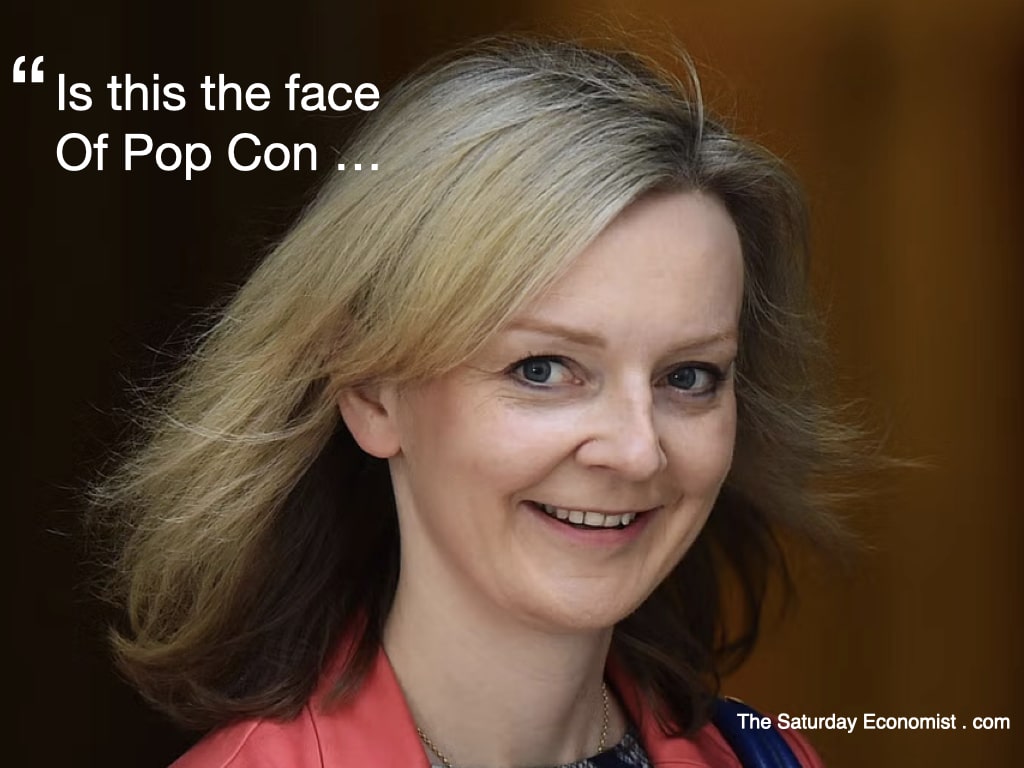
Twenty five points behind Labour, in the polls, over 50 MPs about to jump ship, the Tories continue to fight over the deck chairs on the Titanic, as disaster looms.. Not content with the Balkanization of the Conservative party with five, or is it six families, Liz Truss, who did for Pork exports to China what Rishi Sunak appears to be doing for EV sales in the U.K., is to launch another faction. The Pop Con, faction. The reaction to the launch of "Popular Conservatism" has been mixed, with significant criticism from various quarters, including within her own party, the media, and the public. The initiative, aimed at galvanizing Britain's "secret Conservatives" and pushing back against left-wing ideologies, has been met with skepticism and irony, particularly given Truss's own unpopularity following her brief tenure as Prime Minister. Critics within the Conservative Party have expressed doubts about the necessity and positioning of this new faction. Some Tory MPs have questioned the space "Popular Conservatism" intends to fill, given the existence of other groups advocating for similar libertarian economic policies. The absence of several key MPs from the launch event, including Ranil Jayawardena and Simon Clarke, who were initially billed to speak but later withdrew, indicates a lack of unified support for Truss's movement. The media's response has been both satirical and critical. The Guardian's commentary likened the "Popular Conservatives" to a "Tory tribute act sounding a death knell for irony," highlighting the perceived absurdity of Truss leading a movement for popularity, despite her own unpopularity. This onslaught of satire and criticism reflects a broader skepticism about the movement's impact and Truss's leadership particularly. Public opinion, remains largely unfavorable towards Liz Truss, with recent polls suggesting she is one of the least popular politicians in the country. Ranked 152nd with a 10% approval rating according to YouGov. Widespread unpopularity underscores the challenges Truss faces in rallying support for her "Popular Conservatism" movement. The movement's success in influencing Conservative Party policies and public opinion remains to be seen, but initial responses suggest it faces significant hurdles. Like "do we really need another Tory variant?". The great thing about the Tories, they never stop fighting, the unfortunate facet of action, it always appears to be amongst themselves ... 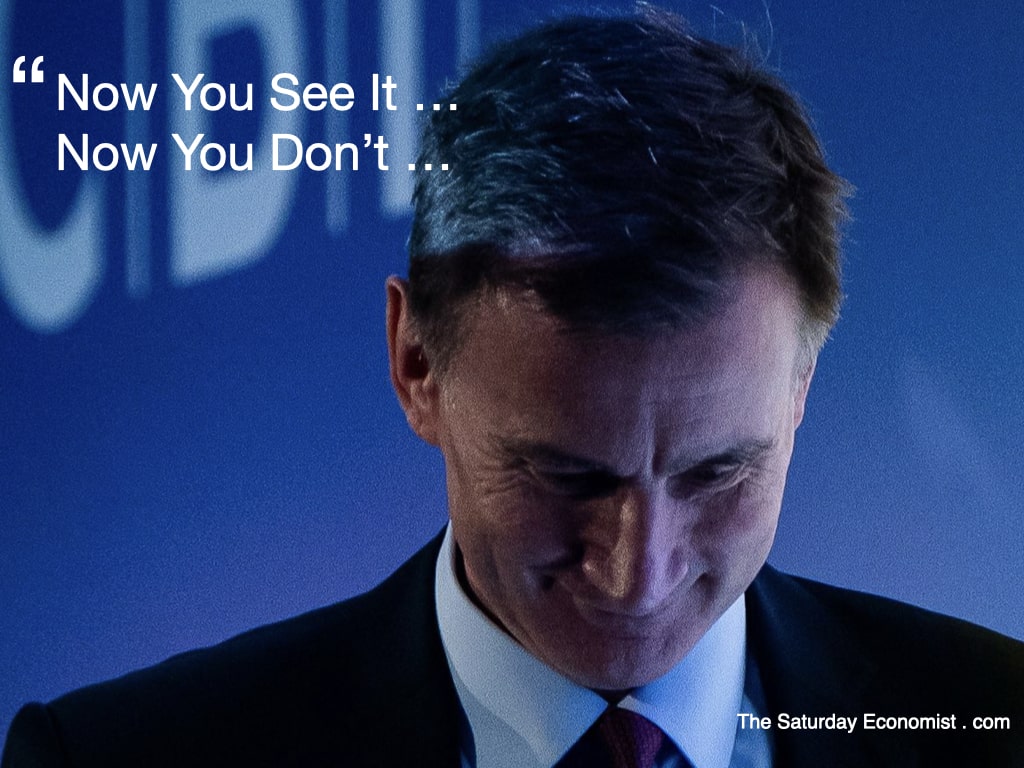 Good news for the Chancellor last week. The government borrowed £35 billion less than expected in the first nine months of the financial year. The chancellor, it was said, is estimated to have, between £15 billion and £20 billion to spend on his budget in March. What a stroke of luck!
Or was it? This week, in a note to self Jeremy Hunt has admitted there is no more money after all. The chancellor, has said there will be less room for tax cuts in the spring budget next month. This, just days after the International Monetary Fund warned that the UK needed to focus on repairing public finances and a week after the OBR dismissed the Treasury spending forecasts as a work of fiction. (The week in which we also warned of the Bond Market Vigilantes). Hunt, who in November announced he was cutting the main rate of national insurance contributions, was widely believed to be gearing up for another tax giveaway after dropping a series of hints about what could be the Conservatives' last budget before a general election. However, the chancellor said he needed to manage expectations. "It doesn't look to me like we will have the same scope for cutting taxes in the spring budget that we had in the autumn statement," Hunt told the BBC's Political Thinking with Nick Robinson podcast. "I need to set people's expectations about the scale of what I'm doing, because people need to know that when a Conservative government cuts taxes, we will do so in a responsible and sensible way." His comments come days after the IMF issued a strong warning to the chancellor against cutting taxes in his March budget, noting that any tax giveaways would probably require extra borrowing or post-election spending cuts. The International Monetary Fund warned against pre-election tax cuts as it downgraded Britain's growth prospects. It said the country should instead curb borrowing and prioritize public spending in areas such as health and education "Preserving high quality public services will imply higher spending needs over the medium term than are currently reflected in the government's budget plans. Accommodating these needs while assuredly stabilizing the Debt to GDP ratio will already require generating additional high quality fiscal savings, including on the tax side". It is this context, that IMF staff advises against additional tax cuts. This follows the statements last week from Richard Hughes, Chairman of the OBR in front of the Treasury Select Committee. The Chairman of the Office for Budget Responsibility (OBR) essentially called the government's post 2025 plans, or the conspicuous lack thereof, a flight of fiscal fantasy. In a striking attack on the government Hughes, said ministers were not being honest with voters about the probable scale of public sector cuts because they had failed to publish detailed spending plans for the period after April 2025. "Beyond 2025 we know virtually nothing," Hughes told the Lords economic affairs committee. "It is just two numbers one for total current spending and one for total capital spending. I think some people have referred to that as a work of fiction. I think that's probably generous, given that someone has bothered to write a work of fiction whereas the government hasn't even bothered to write down what its spending plans are." So we say again, it is all a bit rum. In the space of a few weeks in the autumn, the Treasury, moved from a position in which the Chancellor had no money to play with, to one where he could announce some crowd pleasers because of the effect of higher inflation on tax revenues. Last week, it seems the Treasury moved from a position in which the Chancellor had spent all the goodies in the Autumn statement, to one where he could provide more vote winners in the Spring budget. Now it seems in a note to self, there is no more money for vote winners after all, pressure from the IMF and the OBR not withstanding. It's another episode of "Soap, Life In Downing Street". The intro to Soap, the U.S. Sitcom in the seventies,always began with an intro to the stories of the week and the summary "Confused you won't be after this week's episode". Or will you? 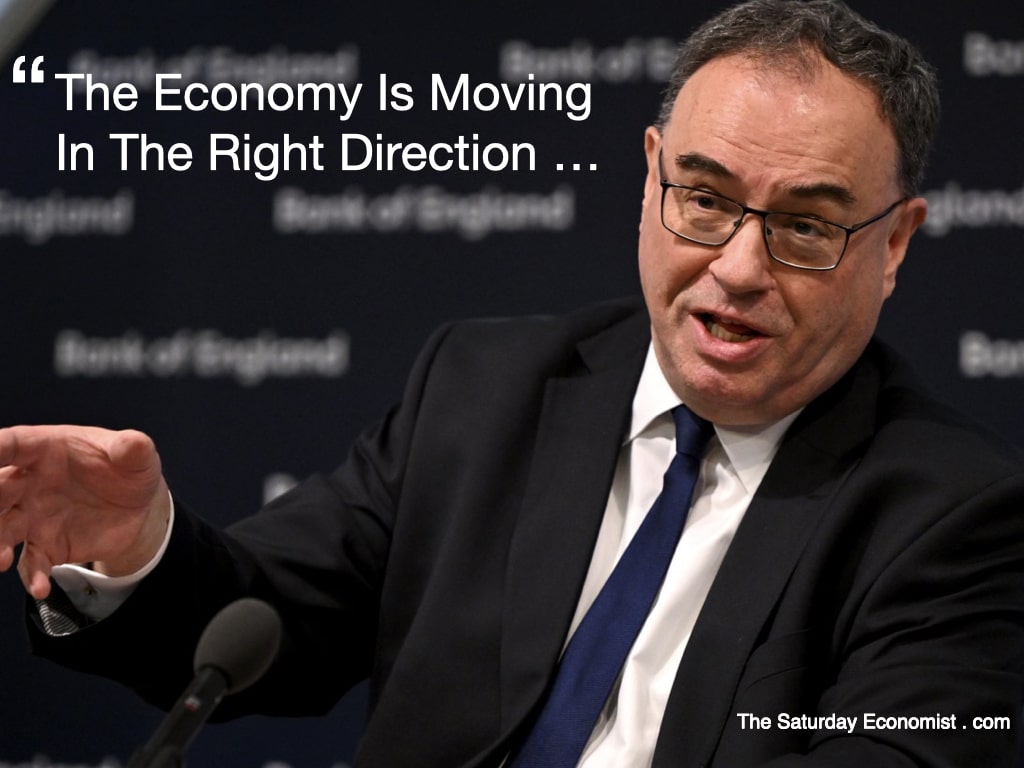 At the MPC meeting this week, the committee voted by 6 votes to three, to hold base rate at 5.25%. So much for group think, of which the Bank is oft criticized, two members voted for a rate hike and one voted for a rate cut.
Swati Dhingra, voted in favour of a 0.25-percentage-point reduction to the base rate, marking the first vote for monetary easing in almost three years. Dhingra thinks the Bank is at risk of over-tightening if it waits for data showing sharp declines in wage growth. Jonathan Haskel and Catherine Mann, on the other hand, voted for another rate rise to 5.5 per cent. They think that wages (rising by 6.5%) are still dangerously high. A majority of six MPC members, including Andrew Bailey, the governor, and Huw Pill, the chief economist, voted for another month of no change. Andrew Bailey delivered a mixed message to the markets, pointing out that the MPC was "not at the point where we can lower rates'. Nevertheless, he said, the main question facing rate setters at future meetings was 'how long we need to maintain this position". This is a significant change in stance. The MPC has removed its previous guidance relating to the need for more rate rises, suggesting that the Bank's next move would be a reduction in borrowing costs. In the US, this week, the Fed also shifted its guidance to financial markets to remove its previous language on the need for more monetary tightening. Chairman Jerome Powell opened the door to rate cuts, without specifying when they were likely to happen. A cut as early as May remains a possibility. Markets were previously exciting about a possible March cut. Governor Bailey hinted at a potential rate cut, markets assume in June. This would mark the first easing of monetary policy since 2020. Andrew Bailey said, "The economy is "moving in the right direction", possibly towards a position that could cause the Bank of England to consider cutting interest rates. The obsession with the "Suite of Models" continues. The "models" suggest inflation may hit the 2% target in the second quarter of the year. Thereafter, the headline CPI rate is expected to rise in the latter half of 2024 closing at just under 3%. (The "models" are also pretty optimistic about earnings and wage settlements). The Governor called for caution, suggesting that while rate cuts are on the horizon, they may not be as substantial as financial markets anticipate. In a later statement, Chief Economist How Pill decided to cloud the market view further. The day after the statements from the Governor, Hugh Pill indicated the Bank may have to raise interest rates, as a next step, instead of cutting them. Pill highlighted potential risks, such as developments in the Middle East, that could necessitate a response from the Bank. He also pointed to sustained inflationary pressures from wages, the job market, and service industry prices as reasons to be cautious about rate cuts. Despite market expectations for a rate cut to 5% by May or June, Pill emphasized that the Bank does not have sufficient evidence yet to support a reduction in rates. "There are dangers from developments in the Middle East for example, that if they were to become manifest we would need to respond to, and that would certainly alter my assessment of the speed or even the direction of future movements in rates". So what can we make of it all? Our overall forward guidance outlook remains unchanged. We expect a series of three base rate cuts in the current year possibly beginning, in May or June. We model base rates at 4.5% in the final quarter. Don't be too surprised if inflation fails to perform as the Bank's ""suite of models" suggest. Models are like that ... 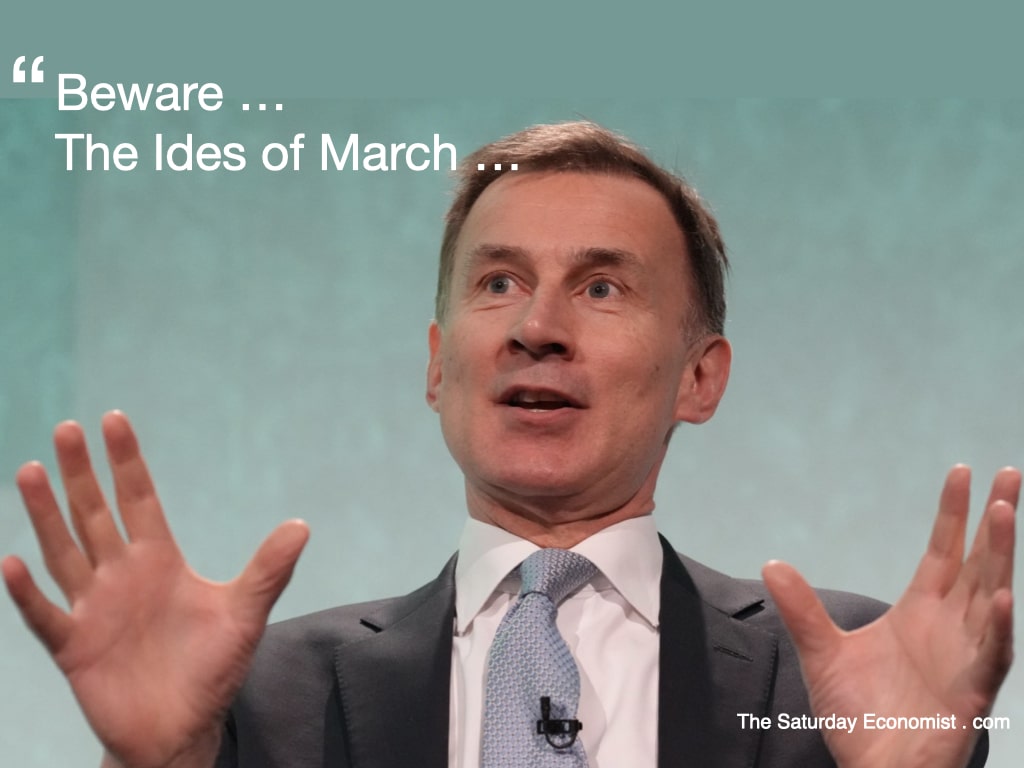 Beware The Ides of March ... The Bond Vigilantes are watching ...
Good news for the Chancellor last week. The government borrowed £5 billion less than expected in the first nine months of the financial year. The chancellor, is now estimated to have between £15 billion and £20 billion to spend on his budget in March. What a stroke of luck! OK don't look too much at the detail, borrowing was up by £11 billion compared to the same period last year. That's an increase of 10%. Pro rata the government is set to borrow £145 billion in the financial year, compared to £130, billion last year. Great things are expected in the January tax receipts data, out next month, to bring borrowing into line with the OBR's £124 billion forecast, so watch this space. In detail, the government borrowed £119.1 billion in the period from April to December, according to the Office for National Statistics, lower than the £124.1 billion projected by the OBR, in the November autumn statement. For the month of December borrowing was £7.8 billion, much lower than the £11 billion forecast by City analysts and the lowest amount in five years. Debt interest spending fell sharply to £4 billion, down by £14.1 billion compared with December 2022, reflecting lower inflation and market interest rate expectations. The OBR commented "The difference with our forecast is primarily explained by debt interest payments, which were $5.7 billion below our forecast profile last month. Inflation has fallen faster than expected. This drop has lowered the amount of cash that the government pays holders of its debt, a large share of which is tied to the retail price index. The latest data increases the chances of Jeremy Hunt cutting taxes in the budget on March 6. The chancellor, is estimated to have between £15 billion and £20 billion to spend at his budget in March. "It's all a bit rum" says David Smith writing in the Times ... "Last autumn the chancellor thought he would have no room for manoeuvre, until a change of forecast from the OBR provided him with the scope to announce a two percentage point reduction in employee national insurance contributions and make "full expensing" permanent. Until then, the autumn statement would have been very thin gruel". says Smith.. "It is, as I say, all a bit rum. In the space of a few weeks in the autumn, the OBR, moved from a position in which the Chancellor had no money to play with, to one where he could announce some crowd pleasers because of the effect of higher inflation on tax revenues. In the few weeks since then, it seems it has moved from a position in which he had used up all his bounty, to one where he can provide even more crowd pleasers." Now it would appear the debt interest payments have been recalculated, to massage way the onerous debt service burden, in the months prior to preparation on the March budget forecasts. 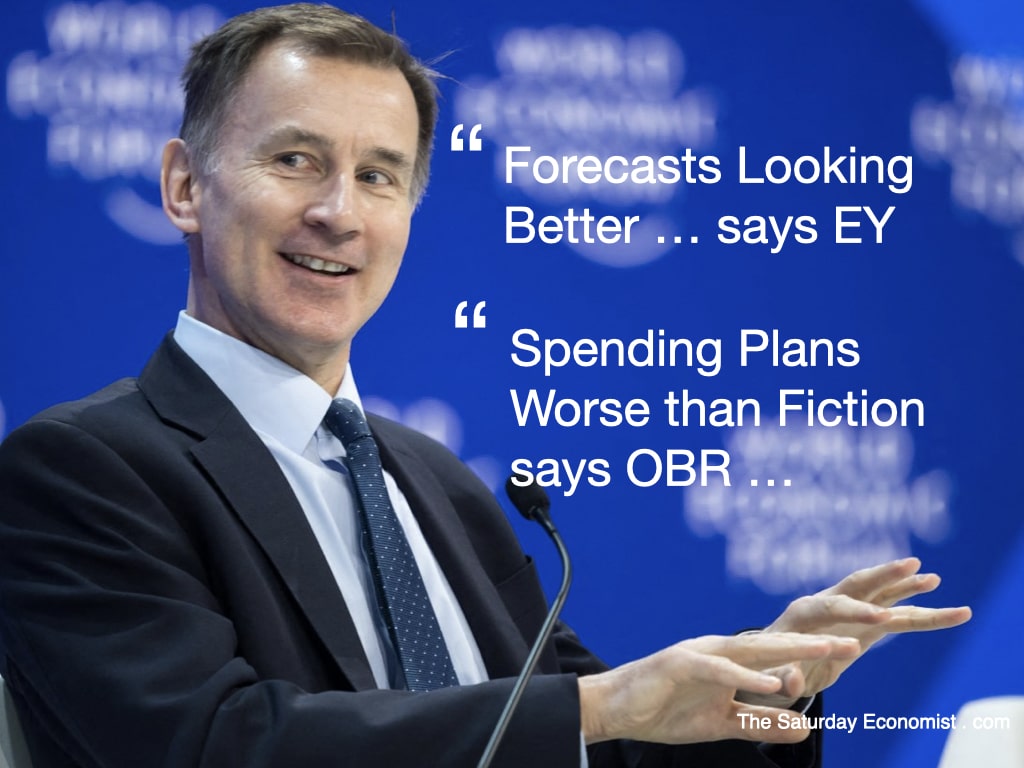 Hunt's spending plans worse than fiction, budget watchdog suggests
Jeremy Hunt's budget forecasts have been savaged by Richard Hughes, giving evidence before the Treasury Select Committee this month. The chairman of the Office for Budget Responsibility (OBR) has essentially called the government's post 2025 plans, or the conspicuous lack thereof, a flight of fiscal fantasy. In a striking attack on the government Richard Hughes, chairman of the Office for Budget Responsibility, said ministers were not being honest with voters about the probable scale of public sector cuts because they had failed to publish detailed spending plans for the period after April 2025. 'Beyond 2025 we know virtually nothing," Hughes told the Lords economic affairs committee. "It is just two numbers one for total current spending and one for total capital spending. I think some people have referred to that as a work of fiction. I think that's probably generous, given that someone has bothered to write a work of fiction whereas the government hasn't even bothered to write down what its spending plans are." Despite the government's borrowing being lower than the OBR's autumn statement projection, the fiscal future is fraught with challenges, including the need to finance healthcare for an ageing population. Hughes suggests that without a fundamental rethink, the path could lead to unsustainable debt. That budgets are akin to "a work of fiction" is a message rammed home relentlessly by economists. Jeremy Hunt's rule to get debt falling by year five of his forecast, they say, is possible only because spending cuts for public services and spending cuts, few believe are plausible, are penciled in far down the line. It is reminiscent of the magic asterisk by President Reagan's budget director David Stockman. The "magic asterisk" was a method to identify future deficit problems that were to be addressed with additional reductions to be announced at a later date. "Cuts as yet to be identified", the concept. Procrastination and a way for politicians to avoid making difficult decisions, the process. The OBR's Chairman Richard Hughes is waving a red flag, cautioning that the government's fiscal fiction and the use of a magic asterisk, could lead to a non-fictional crisis if not addressed with greater transparency and prudence. Meanwhile ... The Bond Market Vigilantes Are Watching ... Bill Clinton's chief strategist James Carville famously said: "I used to think that if there was reincarnation, I wanted to come back as the President or the Pope. But now I would want to come back as the bond market. You can intimidate everybody." The Conservatives risk reigniting the debt crisis that brought down Liz Truss with reckless tax cuts or spending plans, a top bond investor has warned. Pictet, a Swiss bank that manages almost £600bn of assets, said concerns over British stability have not gone away and the markets will be quick to punish financial recklessness. Cesar Perez Ruiz, the company's chief investment officer, warned Labour not to launch a spending spree if it wins the election. He also cautioned Rishi Sunak against unaffordable tax cuts in his attempt to remain in Number Ten. Pictet said he will avoid buying government debt and sterling amid concerns over the general election later this year. He said he was worried about the run-up to the election, warning that "if Sunak wants to get any chance of reelection, maybe he will overspend ahead of it". Debt Issuance is Huge ... According to the OBR, the level of borrowing is set to exceed £400 billion over the next five years. According to the Debt Management Office, the level of redemption, due to be refinanced, is over £600 billion over the next five years. That's a trillion pound funding task for the Debt Management Office. Fortunately, the Bank of England will be on standby, as the Buyer of Last Resort, should the DMO have trouble at the pump. For Jeremy Hunt the caution prevails ... Beware The Ides of March ... The Bond Market Vigilantes are watching ... 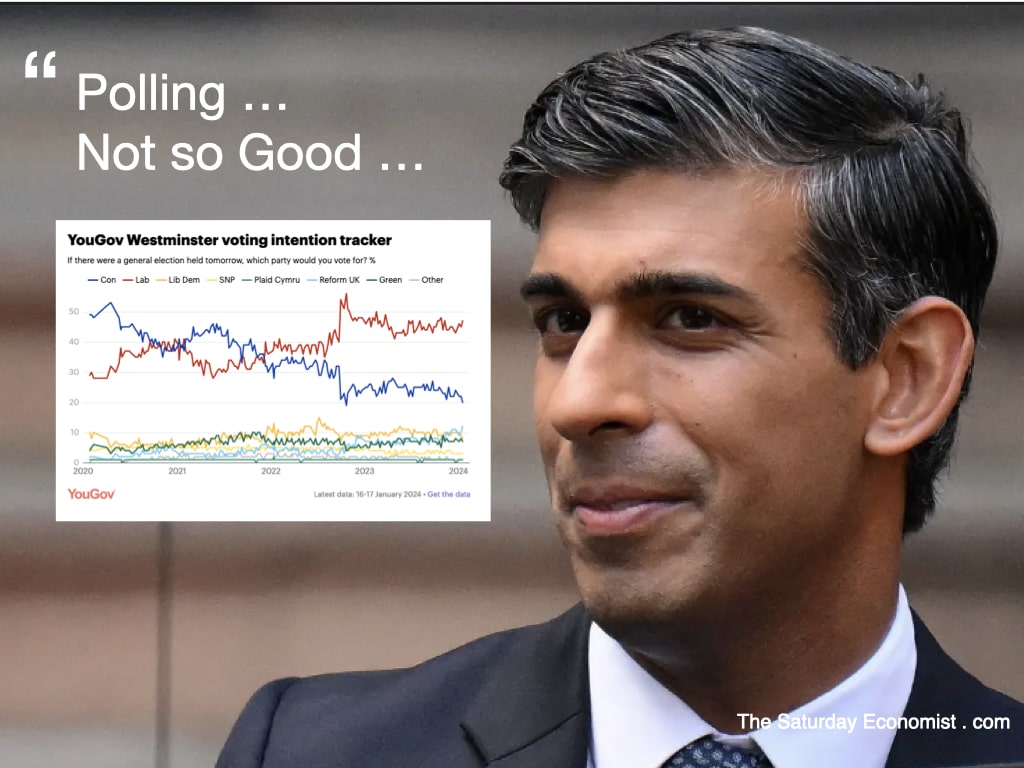 YouGov Polls ...
The latest poll data suggests the Conservatives are on course for a 1997 style electoral wipe out. A major new YouGov survey commissioned by Tory critics of Rishi Sunak, suggests Labour would win a 120-seat majority, if an election were held today. The northern wall would return to natural hue. Cornwall would turn red. Eleven cabinet ministers would lose their seats. Jeremy Hunt, Grant Shapps and Penny Mordaunt would be out of parliament. Over fifty Tory MPs have already said they're going to stand down before the next election (rather than face the humiliation of a Labour Landslide). The latest YouGov/Times voting intention poll shows the Conservatives on 20% of the vote to Labour's 47%. This represents the highest lead for Labour since Liz Truss was prime minister. The Liberal Democrats have 8% of the vote, the Greens have 7%. Reform UK have 12%. That is the highest vote share ever recorded for the party to date. The headline numbers are pretty dire. But Tory tacticians will have a close eye on Reform poll numbers. In competing for the right wing vote, the Conservatives are on 20%. Reform are on 12%. That gives Richard Tice's party a near 40% share (12/32) of the would be Tory vote with Nigel Farage sitting on the subs bench. For Reform, immigration is the platform this time, not Brexit. "Take back control", just as pertinent a slogan as before the Reform brand revamp. Immigration numbers hit 1.3 million over the last two years. Stopping the boats and flights to Rwanda a mere distraction. Net immigration hit 745,000 in 2022 and 673,000 in the year to June 2023. This compared to 93,000 in the whole of 2020 and Tory commitments to hold levels to less than 100,000. An election in November may give time for the economy to improve but also give more time to Reform to organize and secure the £ millions required to effect a large scale campaign. This may push Sunak to risk a May election, forgetting much can be down with a couple of slogans on the side of a double decker bus. According to the Independent, the mood among Conservatives was pretty bleak when they received a briefing from the party's general election campaign boss Isaac Levido earlier this week. The Tory strategist told them to forget about the YouGov mega-poll that puts them on course for a 1997-style wipe out. Levido attempted to "gee up" the troops by insisting he wouldn't waste his own time on a doomed enterprise. "I wouldn't be here unless I thought we could win," he said. Well that and a generous fee in prospect no doubt ... 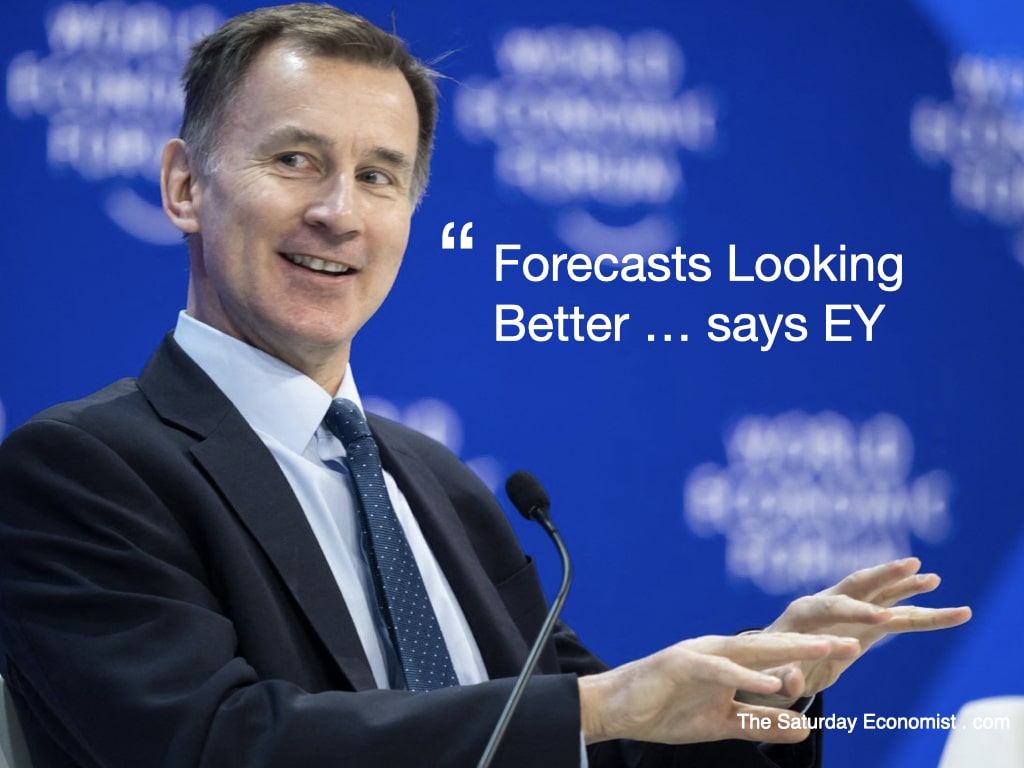 Good news for the Chancellor this week. The EY Item Club has upgraded growth forecasts for the UK economy.
Thanks to a combination of falling inflation, interest rate cuts and tax reductions, the economy will grow more than expected over the next few years. The latest projections from the EY Item Club suggest that annual growth will increase to 0.9 per cent in 2024 and by 1.8 per cent in 2025. Martin Beck, chief economic adviser to EY Item Club, said: "The mood music around the economy is justifiably improving. High inflation and expensive borrowing costs have been two of the biggest obstacles to growth. With both showing encouraging signs of subsiding, prospects for late 2024 and beyond appear brighter." Falling inflation should lead the Bank to make ""a more significant reduction" in rate cuts this year. EY expects the Bank's rate setting monetary policy committee will cut rates by 125 basis points this year to around 4%. This is 100 basis points lower than previously forecast. The EY forecast are slightly more upbeat than the latest "Forecasts for the UK Economy"* released by HM Treasury last week. Growth is expected to be around 0.7% this year, in line with the OBR forecast of 0.7%. In the following year 2025, the OBR are anticipating growth of 1.4%. No forecasts for 2025 are as yet included in the Treasury survey. Our scenario forecast would anticipate growth of 0.7% in 2024 following growth of 0.6% in 2023. Our provisional forecast for 2025 is 1.3% but much will change with an election in prospect this year. Our outlook on inflation is unchanged despite the slight uptick in CPI inflation in December. In detail, inflation CPI basis eased up to 4.0% in December from 3.9% prior month. CPI(g) goods inflation moved to 1.9% from 2.0% prior month. CPI(s) Service Sector inflation moved to 6.4% from 6.3%. Core inflation was unchanged at 5.1%. Food inflation eased to 8.0%, energy costs were down again by -21.5%. The increase in tobacco duties in the Autumn statement pushed tobacco prices higher, up by 16% year on year. Despite the headlines of alcohol and tobacco pushing the headline rate higher, (Alcohol and tobacco account for just 4% of the shopping basket), the major uptick was in service sector inflation. This will remain sticky over the next six months. Our outlook for the year remains unchanged. Inflation CPI basis averaged 4.2% in the final quarter of 2023. We would expect inflation CPI basis to fall to 3.5% by the end of the year. Service sector inflation will be resistant to a more rapid fall despite the further falls expected in energy prices in the Spring. In the latest data average earnings, (whole economy) were up by 6.5% in November. We expect earnings to trend lower to 4.5% by the end of 2024, as unemployment rises and vacancies fall back towards 800,000. Our forward guidance also remains unchanged, all things being equal, base rates could end the year at around the 4.5% level., with ten year gilts in tandem. This we think could well be the standard rate for life, following the great escape from Planet ZIRP. So what of the election prospects? The forecasts for the economy this year and next are looking better. The Chancellor will find some money for tax cuts in the budget on March 6th. A cut in the headline rate of income tax remains the forecast favourite. Inheritance tax may not poll, quite so well, in the focus groups. Tax relief for fox hunting, may also not make the cut. If it's the economy that sways the votes, the Tories are in with a shout. If it's immigration, the boats and waiting lists, not quite so good. The latest opinion polls suggest Conservative prospects are looking pretty bleak ...  It is possible a reduction in income tax and inheritance tax rates could feature in the budget but will it be enough to turn the fortunes of the Tory Party around? In this update we outline our forecasts for 2024. The economy may be flat lining but modest growth is in prospect never the less ...
Economic Growth ... The UK economy returned to growth in November, aided by a better month for services manufacturing and construction. Gross domestic product expanded by 0.3 per cent in November, compared to a 0.3 per cent contraction in the previous month, according to the Office for National Statistics. The year on year comparison was growth of 0.2%. For the year as a whole, growth was up by 0.6% in the eleven months to date GDP growth in 2023 is expected to out turn at around 0.6%. Construction output increasing by 3%, manufacturing output increasing by 1%. Service sector growth up by just under 1%, with a mixed performance across sectors and quarters. So what of 2024? The Office for Budget Responsibility forecasts growth of 0.7% for 2024. The OECD forecasts U.K. GDP to grow by 0.7% in 2024. The UK Treasury summary of forecasts for the UK economy averages growth of 0.7% in 2024. The Bank of England assumes zero growth this year. (Why so gloomy?) Our scenario forecast would anticipate growth of 0.5% to 0.7% in 2024. We model growth at 0.6% in 2023 and 0.7% in 2024. Inflation and Interest Rates ... Inflation CPI basis fell to 3.9% in November from 4.6% prior month. The surprise drop in inflation, larger than expected, is raising expectations of interest rate cuts sooner than the Bank of England has suggested, pushing gilt yields lower. Mortgage rates have fallen. Markets now anticipate the Bank will start to cut rates in the first quarter of 2024, with rates falling to 4 per cent by the end of the year. We remain slightly more cautious. The fall in headline inflation is welcome, flattered as it is by very low goods inflation. In detail, inflation CPI basis eased to 3.9% in November from 4.6% in October. CPI(g) goods inflation moved to 2.0% from 2.9% prior month. CPI(s) Service Sector inflation moved to 6.3% from 6.6%. Core inflation eased to 5.1% from 5.7%. The Bank will remain cautious and quite rightly so. Food price inflation remains high at 9.2%. Earnings remain high at 7.2%. Service sector inflation remains high at 6.0%. Core inflation remains high at 5.1%. As governor Bailey has suggested, "There is still some way to go in Britain's inflation fight". Our outlook remains unchanged. Inflation trends are on the right track. Producer prices are in negative territory. Oil prices remain subdued. Further progress must be seen in food, earnings, service sector prices and core inflation before rate cuts will be tabled. The Bank may just be able to offer a rate cut in the late Spring. April or May remains a possibility. It will be a close run thing. Our base line scenario is inflation CPI basis will end the year around the 3.5% level. All things being equal, base rates could end the year at around the 4.5% level. We assume oil prices will remain subdued throughout the year. The Houthi crisis in the Red Sea will be normalized at some stage. Unemployment ... The forecast for the UK unemployment rate in 2024 varies slightly among sources, but there is a consensus that it is expected to rise compared to the current levels. According to the Office for Budget Responsibility (OBR), the unemployment rate is projected to peak at 4.6% of the labour force, up from the current level of about 4.2%. Our scenario forecasts would assume a slight increase in unemployment from current levels but not by much, possibly at around 4.5% in 2024 and 2025. Vacancies ... Latest data 950,000 (November 2023) we expect the level to fall to around 750,000 to 800,000 by end of 2024, with pressures still persisting in healthcare, social care, retail, accommodation and food. Earnings ... Latest date average earnings, (whole economy) up by 7.2% in November. We expect earnings to trend lower to 4.5% by the end of 2024. The increase in minimum wage will have a modest impact on earnings overall at the macro level. Sectors most affected by the increase in National Living Wage are cleaning, social care, health care, retail, accommodation and food. More Time to Finish The Job ... Sunak has pleaded for more time to finish the job. "The economy has turned the corner, we are pointing in the right direction. Give me a chance to finish the job. Stick with our plan. A plan that is working." he said. The ship (and Conservative hopes) may be sinking, not all will think the party is pointing in the right direction. Eleven months is a long time in politics. And a heck of a long time to keep the five families of the Tory party paddling in the same direction and not abandoning ship . 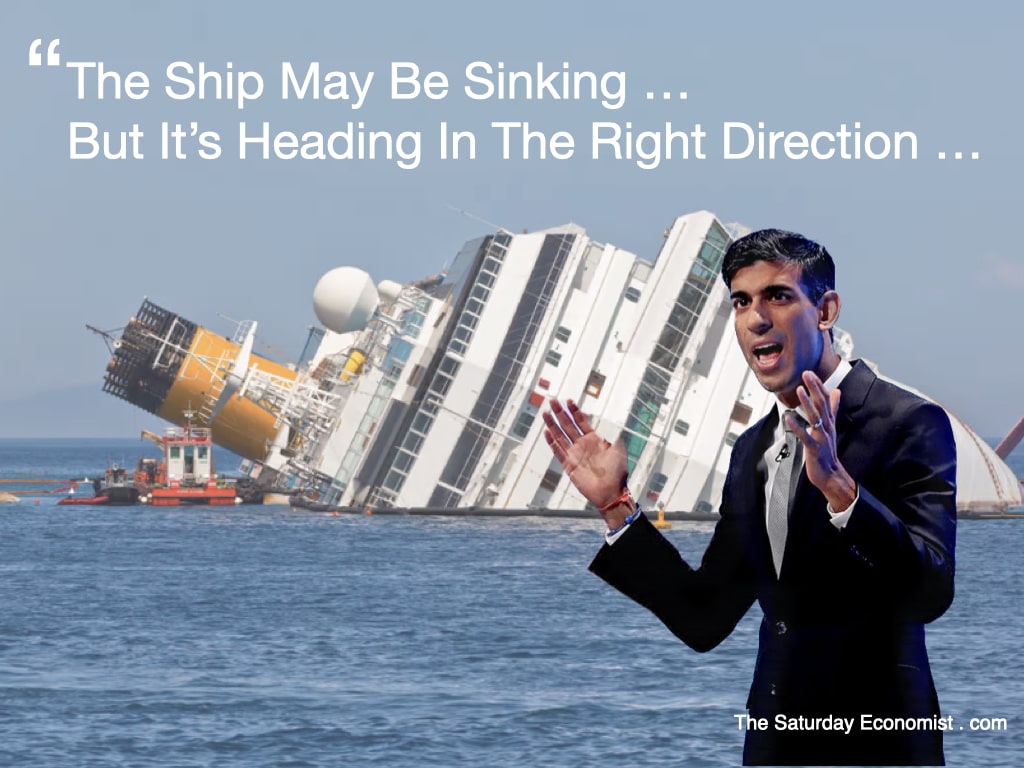 This is it. This is the election year. The date of the budget (March 6th) opens up the prospect of a May election. We would model and assume a May election but ...
The latest poll data released this morning suggest the Conservatives are on course for a 1997-style electoral wipe out. A major new YouGov survey commissioned by Tory critics of Rishi Sunak, suggests Labour would win a 120-seat majority, if an election were held today. The Prime Minister has signaled that Britain's general election will take place in the autumn. His "working assumption" is the UK would go to the polls in the second half of this year. November 14th has emerged as the favorite date. In a recent interview with Laura Kuenssberg, Sunak pleaded for more time to finish the job. "The economy has turned the corner, we are pointing in the right direction. Give me a chance to finish the job. Stick with our plan. A plan that is working." Rishi Sunak kicked off the election year trying to sell to voters that his five pledges were on track. They should vote for him to finish the job rather than "going back to square one". OK, inflation has halved but waiting lists are higher. The boats are still coming. Immigration levels has soared. National debt has risen to 88.3% of GDP. The economy is flat lining. When he made those pledges, Mr Sunak told his audience "people don't want politicians who promise the Earth and fail to deliver". Yet even his own back benchers are having their doubts. Former energy minister Chris Skidmore has said he will resign when parliament returns next week over new legislation "that promotes the production of new oil and gas". Deputy Conservative Party chairman Lee Anderson and other senior Tory figures are voting against the government in favor of amendments to the Rwanda Bill. Kuenssberg has said that 53 Tory MPs have already said they're going to stand down before the next election. Lord Frost, the former Brexit minister, wrote in a piece for The Telegraph that if the Tories do not change course now "there will soon only be smoking rubble left." Grant Shapps, the Defence Secretary, has insisted that the Conservatives can "absolutely" turn around dire polling as the economy improves. Shapps pointed to tax cuts and falling inflation, suggesting that Sunak's government was pinning its hopes on people feeling better off later this year. "The reason I think we can turn it around is because at least people know we've got a plan and we're working to it", he told Times Radio this morning. It is possible a reduction in income tax and inheritance tax rates could feature in the budget but will it be enough to turn the fortunes of the Tory Party around? In the latest update we outline our forecasts for 2024. The economy may be flat lining but modest growth is in prospect never the less ... |
The Saturday EconomistAuthorJohn Ashcroft publishes the Saturday Economist. Join the mailing list for updates on the UK and World Economy. Archives
April 2024
Categories
All
|
| The Saturday Economist |
 RSS Feed
The material is based upon information which we consider to be reliable but we do not represent that it is accurate or complete and it should not be relied upon as such. We accept no liability for errors, or omissions of opinion or fact. In particular, no reliance should be placed on the comments on trends in financial markets. The presentation should not be construed as the giving of investment advice.
|
The Saturday Economist, weekly updates on the UK economy.
Sign Up Now! Stay Up To Date! | Privacy Policy | Terms and Conditions | |